
EASTERTIDE
Morning sun.
Lambs and ewes.
In the shadows
Where frost dissolves:
Cool moved airs,
A glistening reflection.
A movement,
A stillness:
The space where thought
Had been.
—
Posted in Uncategorized, tagged allegory, art, awareness, bleating lambs, digital jiggerypokery, early morning, easter, Haiku-ish, landscape, landscape photography, meditation (definition of), morning, Poetry, sheep, Sound, spring, sun, vision, witness on April 17, 2014| 3 Comments »
EASTERTIDE
Morning sun.
Lambs and ewes.
In the shadows
Where frost dissolves:
Cool moved airs,
A glistening reflection.
A movement,
A stillness:
The space where thought
Had been.
—
Posted in Uncategorized, tagged art, dragons, dream images, dreams, fairytales, folklore, fox lovers, Haiku, Haiku-ish, japan, japan landscapes, kirin, landscape, landscape photography, magatama, mountain monks, mythical beings, night, Poetry, rain, sleepless on May 31, 2013| 2 Comments »

MAGATAMA BLINKS
night rain.
slow breath, flared nostrils
of meditating samurai.
drunken skeletons,
clattering arm in arm,
splashing puddles.
rain passes right through them.
five-tailed white fox
rolls over, kisses lover
and creeps out to hunt chickens.
moon lies back,
shivers,
thinking of ocean beds.
calligrapher practicing
with invisible inks,
worlds destroyed and created.
yamaboushi
splashes down mountain path,
breathing rock and root.
five miles high,
dragons and phoenixes
look down on city lights.
crows shift and grumble
nests full of the stolen dreams
of small children.
magatama blinks
turning into a jade bird,
once then twice.
slightly fuddled,
thinking up names
for new brands of sake:
night rain,
samurai nostrils,
calligrapher’s surprise,
moonlit window,
animal seance,
dancing foxes,
shadow river.
poet weaves clouds,
farts, scratches,
remembers, forgets.
cloud scroll, cherry dark trunks.
hooves of the kirin
echoing in the valleys.
there is no magic outside
the mind.
there is no mind outside
of magic.
—-

Posted in Uncategorized, tagged dragons, dreams, haibun, Haiku, haiku sequence, Haiku-ish, japan, landscape, landscape photography, mind, night, Poetry, wind on May 30, 2013| 10 Comments »

DREAM SUTRAS
Something here in Japan, perhaps the lightness of the summer mornings, perhaps the way the land subtly shivers and sways, perhaps that we are intruders unfamiliar with the nuence of its neural patterns, make night dreams here more vivid. Certainly I awake more often from fright, or from discomforting imagery than at home. An alien technology, or maybe the sake!
in Japan
these eloquent dreams:
still completely mysterious.
Last night, a strong constant wind accomapied us through the entire night. Sometimes I would wake and wonder if a rainstorm was passing overhead, the roar was so steady and insistent.
the long wind
fuelling strong dreams.
mysterious purpose.
Of all the dreams that night there was one particularly convoluted and long-lasting, (or so it seemed). Based around an old man, something of a genius, both an artist and a scientist, as well as an amateur sleuth or criminal investigator. He was involved in many complex layers of research, but was the bane of those who loved and cared for him as his health was failing fast and yet he would not take rest nor ease up on his schedules.
Long wind,
who is the dying sage
so eloquent and ancient, in my dream?
dragon wind
dreams of sages
utterly bemusing.
An interesting point I saw recently on a post about haiku was that amongst the many ‘rules’ was one that stated that a haiku should make no comment. Haiku as a record of perceptions that can evoke numinous emotion without explicitly saying what the emotion should be. Like a haibun, a haiku can lead to endless mazes of commentary and extrapolation. A thought motif, a riff, a theme, can lead to jazz-like improvisations. Now, this rule is not one of simple objectivity. The poet is always objectifying the internal as well as external. Perhaps it is the avoidance of the passing of judgement, not reinterpreting or making a second or a third judgement, that makes haiku resonant, that prevents it simply becoming a commonplace sentence divided into short lines. Who knows…
how many miles is this long wind?
night-long it roars through the curtains.
even my own dreams
are a complete mystery to me.
Haiku, seen as a child-like entrancement (entrancing entrance), a fluidium between self and not-so-self. Paying attention to when nothing is happening, we discover that something is…
roaring dragon wind
how many miles
do you traverse?
as wide as the moon:
this long wind
over hills and valleys.
There is a shamanic, primal sort of awareness in the best haiku. An overlay of worlds. A denial of incorrect or correct ways of perception. Juxtaposition, significant only because it is juxtaposed. For an instant, in this mind, and then in the mind of the reader, sense data and interpretations hold equal value, are equally valid, equally ephemeral.
long wind,
aching bones.
mysterious dream
of ancient sages.
maybe it is my aching bones:
dreams of ancient sages
and steep hillsides.
long night wind.
my dream too,
arising from distant lands.
dream sutras
though inexplicable,
endlessly fascinating.
Finally, the long hours of the night begin to move away, light edges between things, but the wind, having blown away most of my thoughts, still remains.
long wind
blowing away night
to other lands.
In daylight, the warm airs sweep yellows and golds. The palm tree still shaking its dry fronds between the houses, laughing, dancing, bending, chanting.
cats in the sun
eating, sleeping,
composing haiku.
—–
Posted in Uncategorized, tagged chant, gardens, healing, invocation, japan, landscape photography, Poetry, return, Rig Veda, soul loss, spell, statues on May 28, 2013| Leave a Comment »
—-
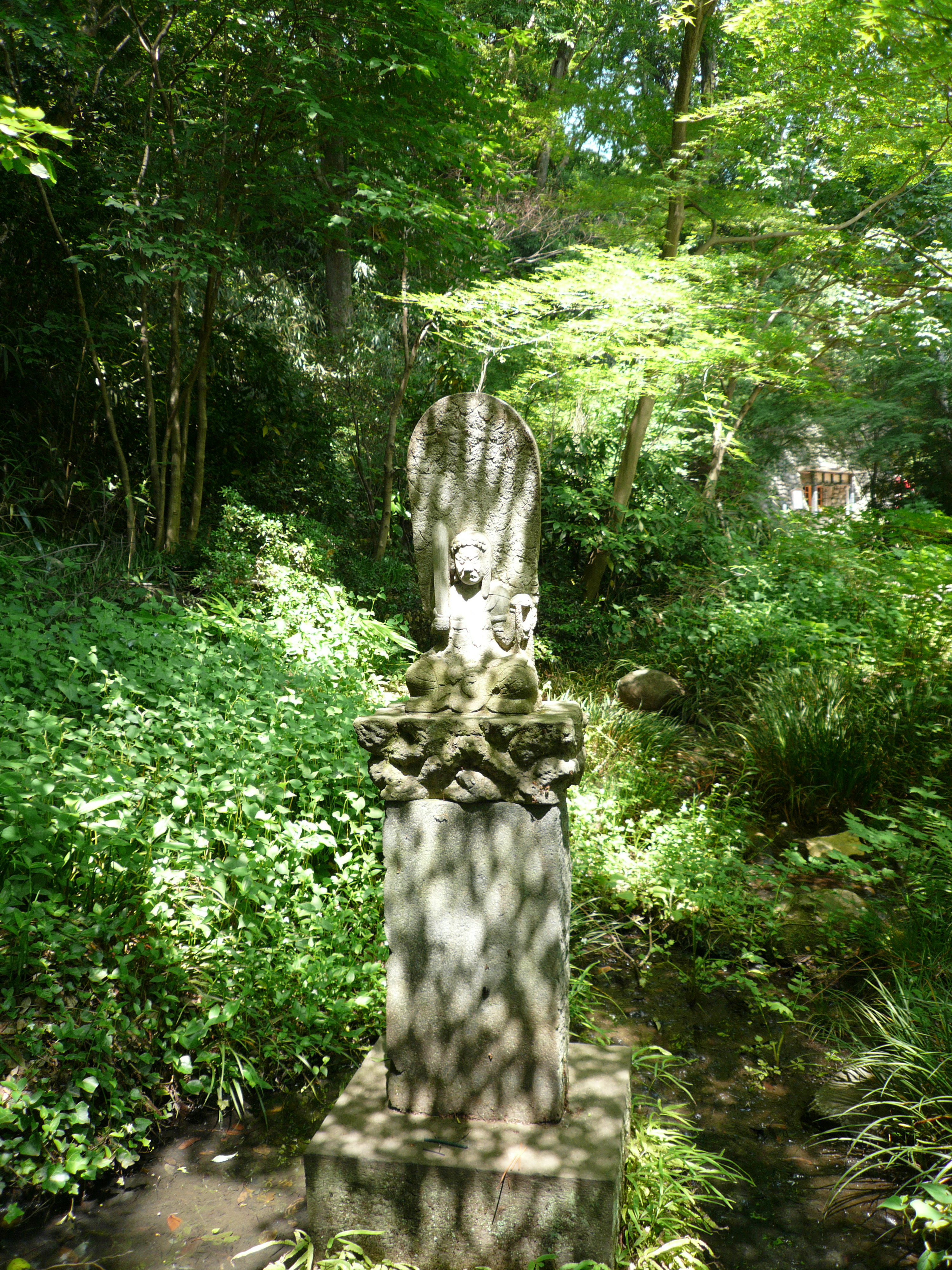
JAPANESE SYMPHONY: 6th MOVEMENT, INVOCATION TO RETURN
although thy spirit wanders in what has been or in what will be,
i bring back that spirit of thine, to dwell here, to live long.
although thy spirit be far away, lost in lip-cracked desolation,
i bring back that spirit of thine, to dwell here, to live long.
although thy spirit be far away, fled beyond the seven oceans,
beyond the stilled, rippled wave,
i bring back that spirit of thine, to dwell here, to live long.
although thy spirit be far away, in the sun, in the moon, howling
between the stars, lost disconsolate,
i bring back that spirit of thine, to dwell here, to live long.
although thy spirit has gone far away, to the proximal regions of space, seeking warmth at the fires of the old ones,
i bring back that spirit of thine, to dwell here, to live long.
although thy spirit is raven-ripped, claw-tongued, dipped dark
in deep ravines of anger, lost, raving,
i bring back that spirit of thine, to dwell here, to live long.
in the silent forests, in the wild forests, in the nurturing forests, in the hopeless dawn, in crumbled twilight,
i have here given your soul its own name and it must answer.
it will gather up, and it will be gathered up,
it shall become winged and comforted,
it shall return, it shall return.
—–


