Feeds:
Posts
Comments

036DunveganShore

9 : Hunger

Across the long years
Most falls away forgotten.
Only a few fragments of song
On the scented wind,
A few stinging scars, tight and bitter,
Too highly regarded, dog-ends
Of disastrous choices,
Fit meat only for tales
Not for policies, not for futures.

Where there is gold:
There the cold-eyed, sly-smiled gather.
Where there is strife:
The carrion-eaters swoop in.

The hoodie cries
(Pecking at the eyes and brains of lambs),
Give us our freedom.
Too long have we been hunted,
Hung slack and bloody on barbed wire.

The martens cry
(As they bury into the bellies
Of the flock),
Give us our independence
To feed where we will
The endless, remorseless hunger
That comes summer or winter,
At ice-melt and frost fall.

The wily foxes circle,
Scenting an opportunity of gold,
Warm red crunch
In the dark hay loft.

To be left at peace
To be unhindered and honest,
Not to be slighted nor chivied,
Herded and diminished,
Nor subjected to the slow death
Of parasites,
Their cunning confusions,
Tongues of deceit,
Gold-grabbing fingers.

The freedom to belong
Is born with your each new breath,
Not with long lines of bloodshed,
Not with boundary stones.

Only when the bones crumble,
Where the fat feeds the soil
When the breath sighs, mingling
With the sedges on the loch-side,
Do we wholly belong.

Those who stand here,
And those who have died here:
They have the right to belong,
Like old MacLeod belongs,
Named and pinned under heaven
Until Time wipes even
The slumbering mountain away.

The ocean river squeezed through Sleat,
Fast, eternal,
At last leapt by stone.
The distant shore, desolate, silent
Hands reaching, never meeting.

Where you make your centre
Is where you are.
Where you belong
Your heart alone knows.
There is no language worth speaking
If it is not in kindness.
That it moves, whether fast or slow,
Voice and song
Are our only gifts to the universe.

We are not adversaries who struggle
For small freedoms, for the upper hand.
There is too much to be lost,
There is not enough to go around,
Never a second chance
When the wolves make the choices
Of who and when and where
A sacrifice is required.

From what will you escape?
What fiscal policy,
What redistribution of wealth,
Will free a pinched, aching heart
Filled with fear and debris,
The slurry of history,
The failures of others.

I have tasted a whisky in the hills,
Honey warm and smooth,
That in the city burned black and harsh…..

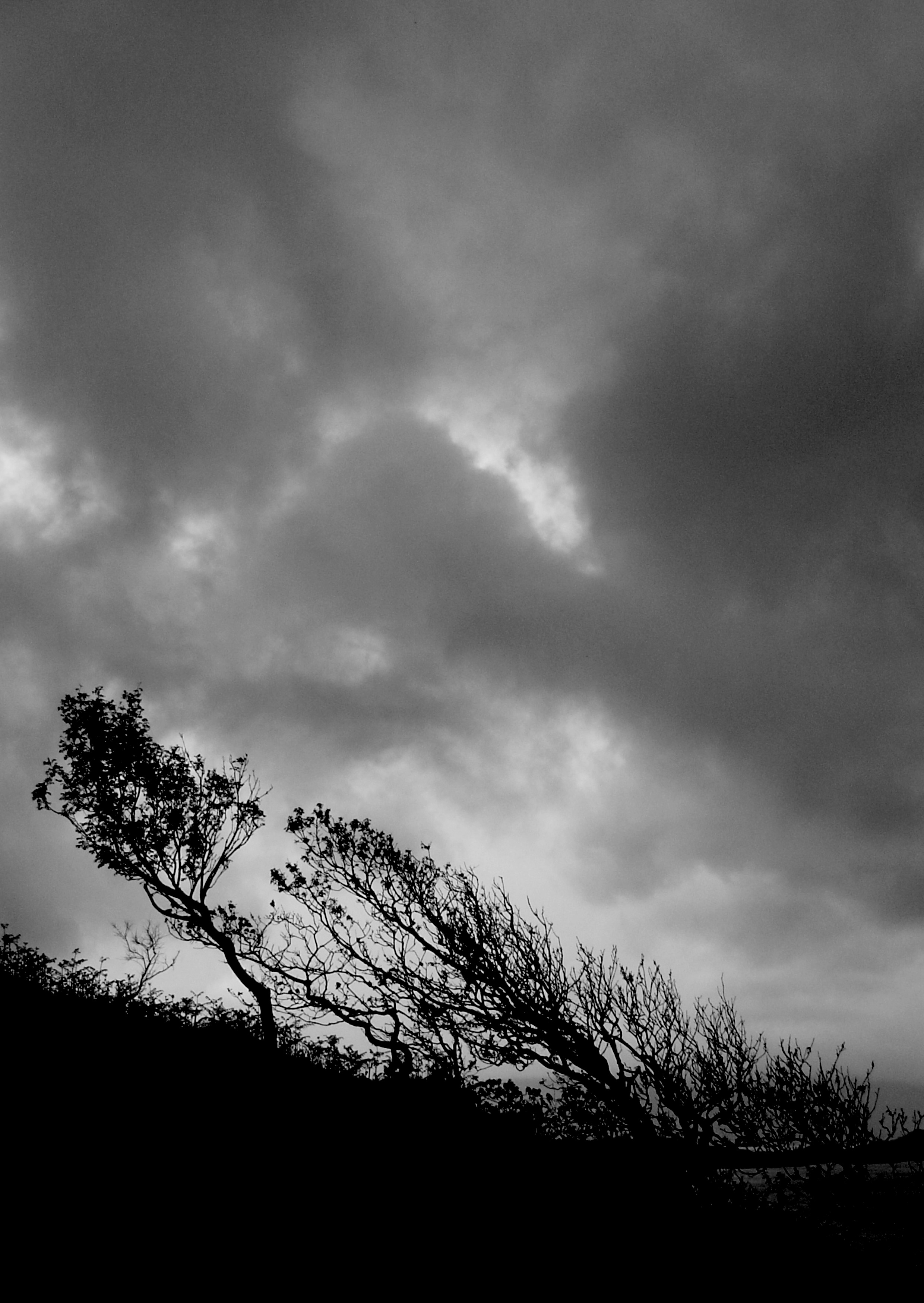
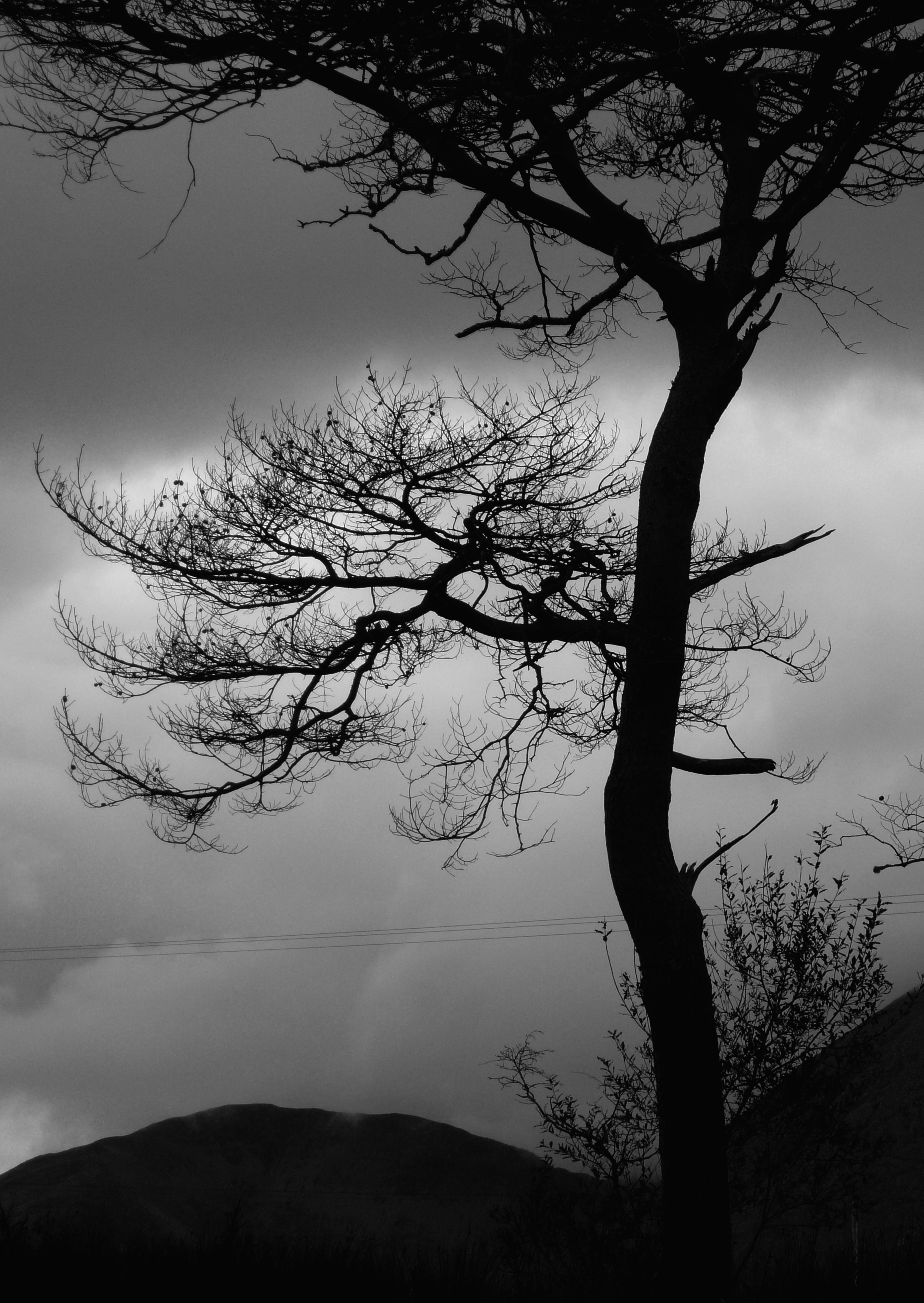
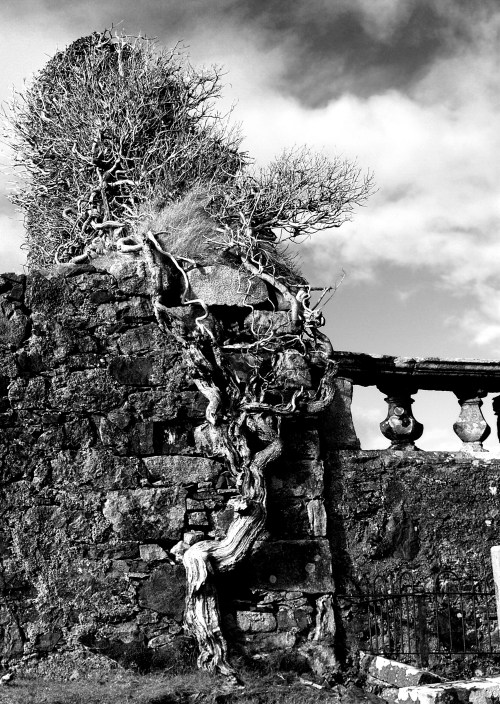
hawthorn,Ord

windswept

7

The long song

The song is always: if only.
(Not the song of the trees
Not the song of the falling waters,
Nor the wind that carries the grey storm wrack),

But the song of those huddled about the fires,
Bone thin, crack-voiced.
And the song too
Of the squire and laird,
Dissatisfied with their winnings,
Their great gambled losses.

Only those covered by the hills
Covered by the rath, the dun,
The hawthorn bent and ringing,
Only the eternal dancers
Have found another song,
Abjuring Time,
Disregarding judgement.

They sing of the edges between things,
The instant when one slips into other,
The knife blade of love into hate,
The cry of the oystercatcher
That spins from joy to grief to joy,
And is all and is none of these things.

They know the call of gold,
Have tasted its dust.
They know the answer to freedom,
(What all seek and none understand),
Have left it, found it,
Given it up.
Those in dream need no other dream.

Those who know they are in dream
Delight in twilights,
The subtle glance,
The hesitant dance.

But here, bombastic, needy
Sure of something, the nation stands
Once more calling for something
That cannot be given.

It cannot be given,
This independence, this freedom you seek.
It cannot be offered, it cannot be bargained for,
It cannot be voted in, it cannot be passed in law.

You will never see it, never reach it.
Nor is it a haven, a prize, a reward, a right.

The house of freedom
Is the empty wall by the long shore.
The house of independence
Is a house open to clouds,
A mist of trees within.

falls

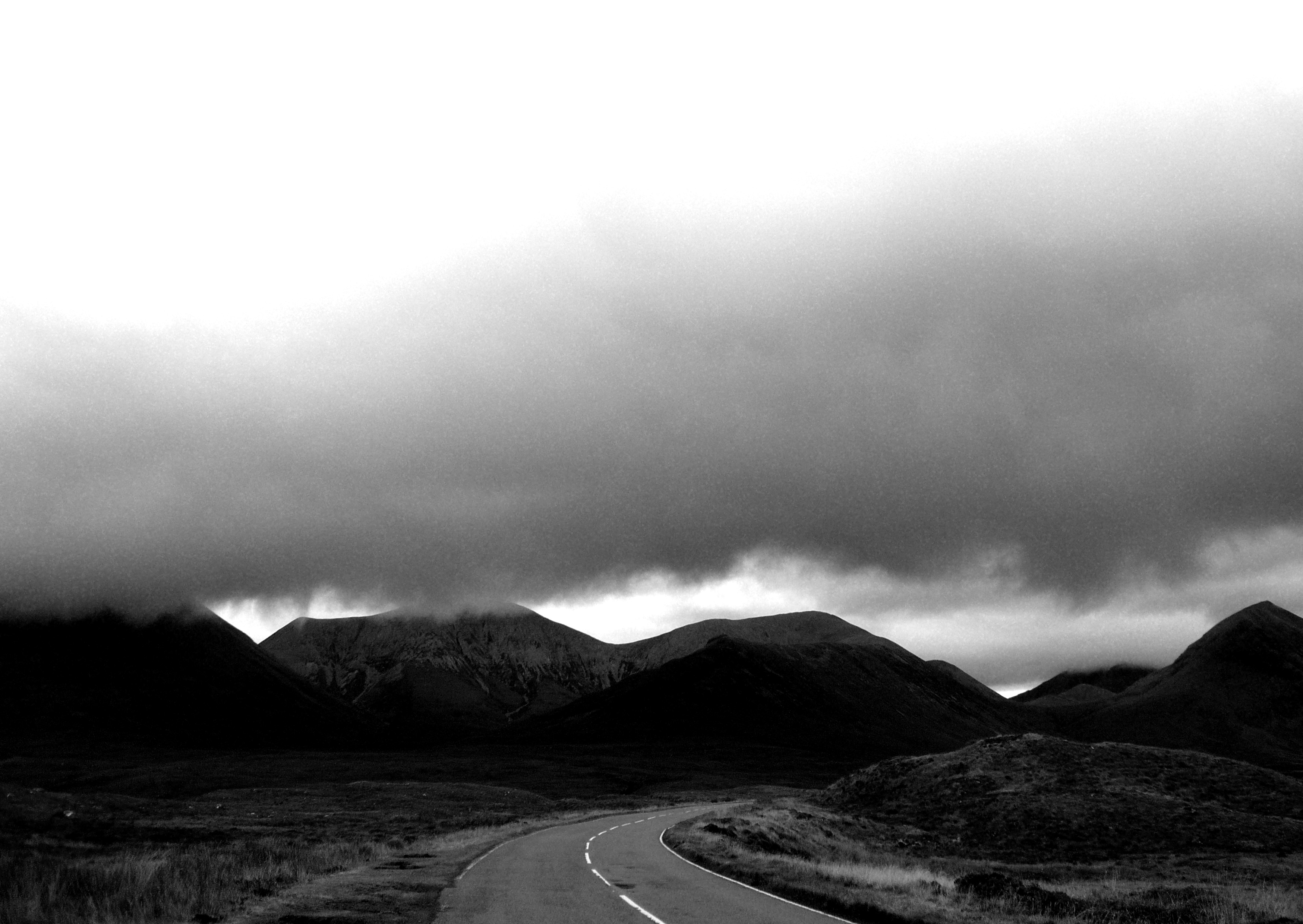
Skye road

6

The fairy bridge

See the cars speeding fast and low
Along the thin, black tarmac ribbons,
Crisp laid over the rolling moors.
Hardly noticing,
Oblivious to the blur of heaped stones,
The dips and corners of bypassed histories.

Speeding around the proud, sleek corners
Leaping the old valleys left silent, shaded.
Easy, then, to miss the Fairy Bridge
Where MacLeod of Dunvegan
Found and lost his fairy wife
In a place between here and there,
Neither rock nor water, earth nor air,
A hunched road between hunched hills.

Left in sorrow,
(Impossible to span such a distinction of worlds,
Falling asleep for centuries
Or cursed with too much guiltless joy,
The dance never ending),
He returns to his empty home with a last gift:
A flag, furled against desperate times,
A promise of three victories out from despair.
Doomed to crumble, disappear in tatters,
Worm-eaten, forgotten, misplaced, tear-stained.

A thin withering, a frayed thread,
The clear glory imagined now dust,
A past that bartered its continuance
Without suspecting anything except valediction,
The clear glorious road ahead smudged with sunset storm,
A dark path abandoned by light.

The Fairy bridge,
Between time and space, here and there,
A feather touch of fame and fortune,
A moth touch of death, a kiss, a whisper,
A foot placed right, a foot placed wrong,
A slip, a sliver, a glint of gold, a refrain coded,
A yearning, a whole nation beguiled,
Mazed, lost, cast away,
(The blue distant shimmer, the smooth green hillside of freedom).

He doubts now:
Did he dream it? The long years of love and laughter,
The line and weight of beauty,
The grace of hand and fall of cloth?
And what was the cause?
What was done, what left undone,
What path unnoticed, what riddle unsolved?
What required answer not given
At the right time, the right place?

The song is: if only.
The grief of not knowing, or of knowing too late.
Gold cast away into mud, the firm, fast knot slipped.
To give and take is sacrifice,
To give the most must lose the most.

Swept away,
They have all been swept away,
By time, by foolishness, by a repayment of debts.
The land parceled, emptied,
Lorded over, an amusement for weekends,
A respite from care,
A cleared killing ground,
A desolation of aristocracies.

ferns

From Broadford

5

      The house at Luib

It is not the same,

There on the other side

Of Beinn na Caillich,

Beside the dark loch waters,

Still and brown.

Beside the heron-guarded

Loch of Ainort.

The houses of stone

Grey-walled,

Under shadows.


It is not silent,

The house at Luib.

For how can a thing

So merged with the world

Not be full

Of the whisperings of the world,

Its sighed breathings?


Not mice, though,

Amongst the rafters,

But birdsong.

Nothing but a thatch

Of cloud

And a drift of mist

Above

The moss-green

Tumbled walls.


No door

To open in welcome.

No scent of peat nor brose.

No fire at all,

Except the spark of sunrise

And embers at evening.


A house of trees,

Whip-thin and tall:

There together birch and rowan,

Maple and willow,

Carpeting the hearth,

Scattering green and gold

(more gold than this house

Ever saw before,

And of richer worth than metal:

Bestowing the soil,

Brightening the eye

On autumn paths).


Those who called this home

Shall be long, long gone.

Not sleeping near

Listening to the oystercatcher

On the shore,

The raven

On the slopes of Scalpay.


They will be lost

Across the seas.

Deserted by kindness,

Faces washed in salt,

Eyes empty of hope,

Hollowness growing

By the long mile.


And so it is

A house of trees,

A conversation

Of saplings.

This house empty of laughter,

Empty of singing.

No longer the home of men

Nor the smell of wood-smoke.


The bright trees growing,

Their root sinews sucking

The debris of memories:

Branches conversing together,

A chattering of leaves.


The old, sweet language

Sighing away

On the wind

Over the dark waters.

A soft calling

Of the lover to bed;

A hum, a song,

A tune for working;

By the fireside:

The telling of tales –

The day’s pouring,

Silver, gasping catch

Out on the wave.


So they have all become trees.

The memories growing to stories.

Casting seeds,

Changing with the seasons.

Our thoughts,

Boughs and branches.

Our intentions,

An agitation of leaves.

Our dreams,

Rooted hidden, out of sight

But deeper,

Deeper than we would even guess

Sustaining our place

Gripping rock:

The spinning world.


We would want for nothing

In our own place of belonging.

No distant yearning,

No sad lament

(except the lament of edges).


For always the living

Wraps the dead

As the ivy the stone

As the moss and lichen cling

’til they too become sky,

A dust

On the storm winds

Of autumn.

Beinn Na Caillich, Broadford

CillChroisd2

The House of Trees

4

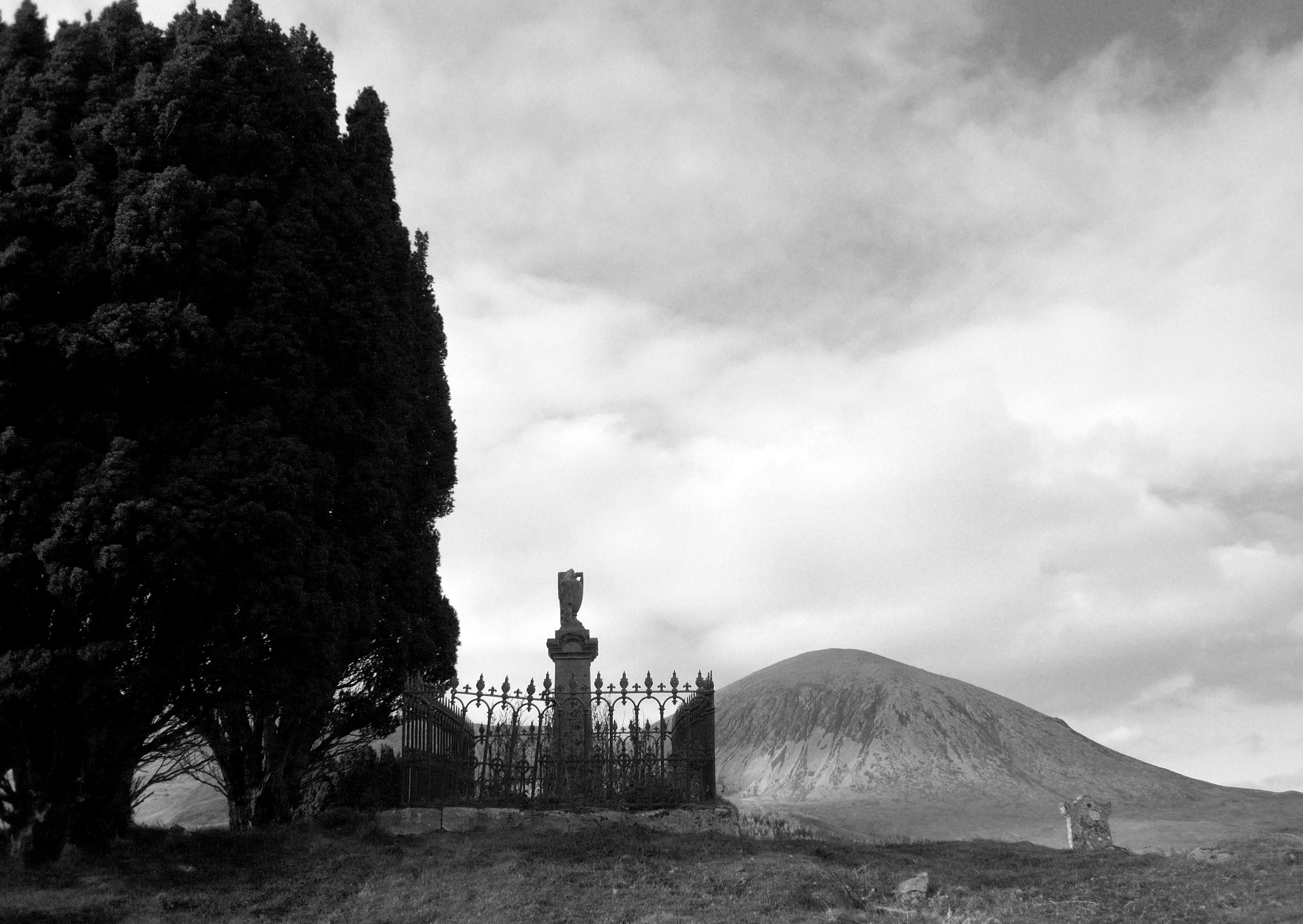
       Cill Chroisd


On the road to Elgol

That dances its way

In the dark and light

Of moving skies.


Breathing up and down

Sliding beside loch and ben.


Between the green toes

Of Beinn na Caillich –

(she, who, giving birth to the land,

Remains unconcerned

But ever watchful)


Beneath the raven’s wing,

Beneath its long, far cry;

Amongst the short grass,

Sheep-cropped and hummocked,

A blanket fit for sleep and dream,

They have placed the corners

Measuring the ordered landscape

Of the dead.


Here lies a MacLeod

Under the brown breast

Of Beinn na Caillich.

He has not angels by his head,

Nor angels by his feet,

But four eternal trees –

Green flames of yew –

To shade him from too much sun,

Too much starlight.


Four trees

Grown from his bones,

Fed by the exhalation

Of his long sigh in sleep

And promised rest.


They will be a shelter

From the four quarter’s winds

That winter howl along

The dark glen.


They will be a shelter

For the small birds

Singing him joyful

‘Til his Judgement.


A sure roof

Outlasting the crumbling of walls –

The green, sky-stretched,

Wind-hugged branches

To bear him back home.


Here he shall have peace.

Peace, but for the hooded crows.

Peace, but for the sheep

Tugging the small, green tumps.

Peace, but for the passing wanderer, curious.


They have built for him

A house of earth

For the earth of his body.

They have planted for him

A house of trees,

Seeded from his flesh,

Grown from his sinews

So that he can live for eternity

In holy wood.

They have built for him

A house of song-

The wind in the ivy,

The swan and the curlew-

For his soul to stretch out.


Who would not want a mountain

As a headstone?

Without cold in the bones,

A delight to watch for centuries.

Without a watery eye:

The storm winds, a delight.

And to drink the peace

Of the cloud-tangled rushes

In the evening and morning time,

Rippling with diver and otter.

Who would not melt to moorland?

Rich peat mixed with memories

Of the long-gone,

The onward patter of rain.

110RoadToElgol

Kyleakin evening

2

 Weavers of the Sidhe

Two came at twilight

From the rath,

Cold with curiosity,

Small as children

But with strange eyes

And smiles too old,

Far too old.

To see who it was

Carried the silence

By the shore

That was not the grey heron’s;

To judge the cry of one

Neither curlew nor oystercatcher;

To weigh the harsh throat

Not of the hooded crow

Nor of the raven.

To find the mote

In sunlit attic,

It’s dance to forgotten harp

Dusted earth, dreamt melody –

Dream nerves tied to sing of rock,

To follow the dancing road.

When they speak

Small blue flames flicker

Upon their tongues.

Their eyes –

Corridors of starlight

From distant galaxies.

Their thin fingers

Cat’s cradling

the centuries.

They are the same

Our ancestors knew:

Changeless,

Dissolving in midday light,

Returning at twilight

With shadows dancing.

They belong to place,

But not to time.

They are the rolling,

Rising, blue distance-

Yearned for,

Unattainable.

032LochDunvegan

3

The Secret Commonwealth

Cast out,

Cast down

From Heaven’s brilliance.

Not falling for the passion of rage,

Nor swayed by the unforgiving violence

Of righteousness,

(The simple, clear lie

of polarities, justice, truth).

Condemned by the Most High

For failing to take sides.

Falling down,

Down

Into twilight.

Neither here nor there,

Backwards or forwards.

It is why they flock to song,

Delight in the poet,

To what moves by its stillness,

What reverberates with passion,

Profound ephemera,

Guileless illusion,

Flash of gold,

Uncertain Reality.

Shot-silk seasons

Rich with the Opposite.

Reflection on reflection,

Echoed echoes.

Not dead, nor living

They are the rolling, rising blue distance,

The accumulation of dream,

Repository of yearning,

Perfume of nostalgia.

The processions, the slow

Dance:

Terrestrial constellations

Caught sight of peripherally,

Oblique,

Canny,

Ambivalent,

Unnerving.

Bane of priests,

Defiers of logic.

Snake language – fast

And sparkling.

A danger to mortal dreamers

Who might fade

Into the world,

Feather roots merging,

Knowing and edges blurred

Into the song of presence.

Perhaps returning,

(if at all)

With a fragment of lament,

An air,

A pavan,

A secret wrenched from time,

Lost within time again,

A wonder,

A treasure,

A mystery unholy,

Disengaging from certainty.

Duirnish sky1

CillChroisd

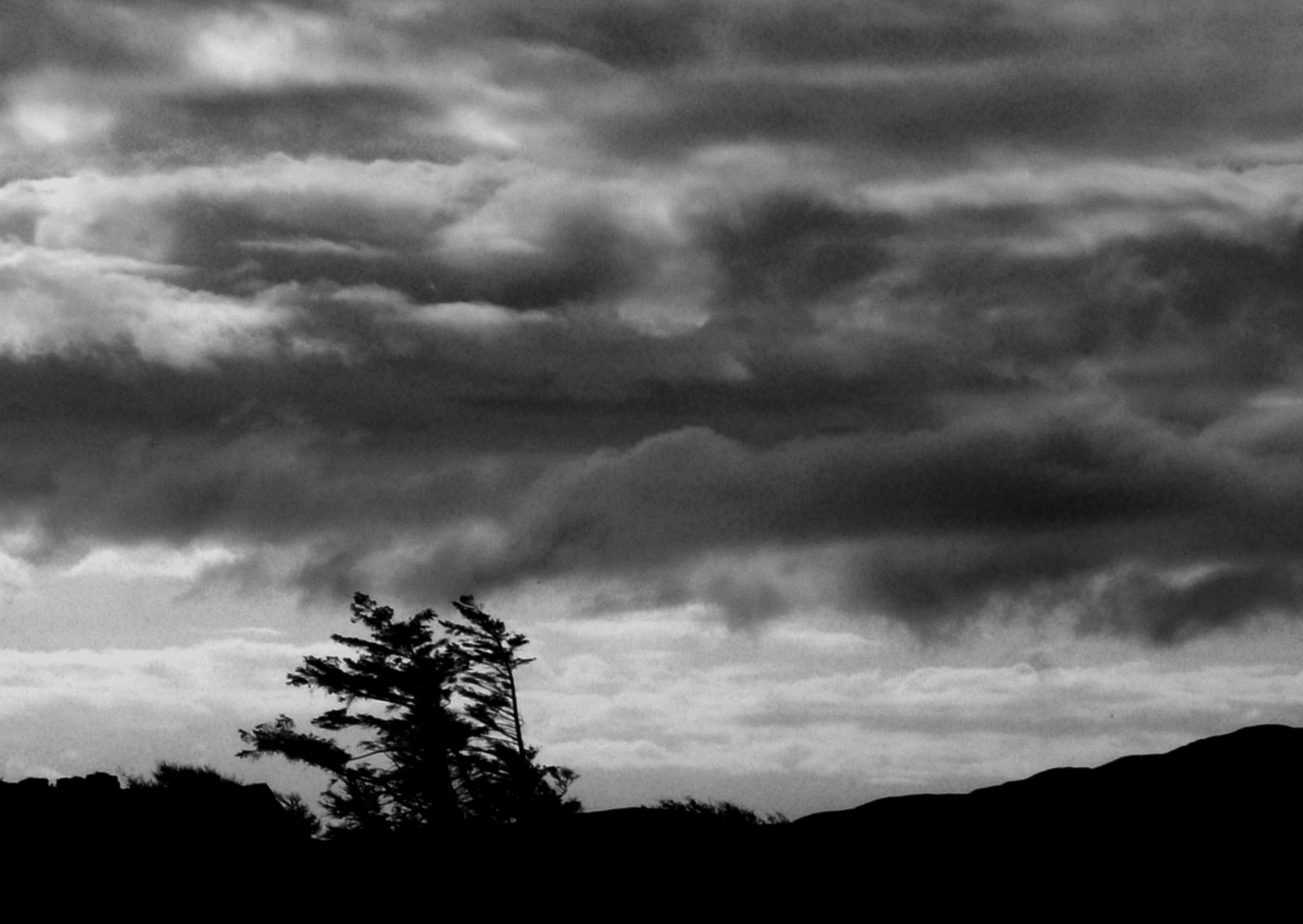
So, since our trip to Skye in late October I have been alert for fragments of a long piece called “The House of Trees”. It is an archaeological process: I have seen the overview, the aerial photographs of anomalous markings. I suspect the subject matter, what lurks below the undisturbed  grass, intimations of structure, an outline, a definite definition. Season by season, I return to gaze from different angles ( the low light or high light revealing something or nothing), tentatively trowel away a little soil ( gold being such a flighty treasure, turning to tin can or brass if not approached with delicacy). Gradually an accumulation of relics, lines, phrases, rivers, posies is piling up. So I have decided to display some current finds, unreconstructed, scrubbed, labeled.

The sections so far can be defined thus:

The pivotal images are a small derelict burial chapel beside a moorland road. Initially I was drawn to it by a large twining ivy plant, white and bone-dead, crawling up the roofless walls. But also a small group of yew trees under which a relatively new gravestone had been placed, so that they acted as a living green monument, evergreen in a windswept, wan landscape.

On the other side of the island, on the main road to and from Portree, we passed several times a deserted croft, again roofless, but this one filled with a copse of young trees. It was not in the middle of nowhere, but on the edge of a small village, newer houses just a stone’s throw away.

Both images of time, of mortality, of people living and passing on. The history of Scotland is depressing: bleak repetition of small conflicts, betrayals, squabbles, misunderstandings, bigotry, famines, disasters, displacement, loss, exploitation of the poor by the rich. As such it is not so different from any other nation’s histories. Perhaps Scotland’s historians were less persuaded by a ruling elite to gloss and gild the facts. The small population, the difficult terrain, has meant that lost villages, deserted houses have not been swept away by succeeding generations. The bitter, unthinking inhumanities that so stain a country’s historical development still remain, accusing, daring the passer-by to forget at their peril.

And the rigid, bombastic stupidity of councils, governments and landowners often encourage a wistful nostalgia for something that never was – a free and unified nation.

The romantic, Isle of Skye, (and by God, it is romantic), for example was parcelled up between bellicose clans, each taking possession of one of the peninsulas. MacDonalds, MacLeods, MacGregors and more, all continuing the Celtic Iron Age ( British) tradition of cattle raiding their neighbours, taking hostages, not trusting each other.

And parallel to this, the mythic grandeur of the Highland imagination ( again, a relict from pre-Christian cosmologies). The Second Sight, the Secret Commonwealth of the Fairy Nations, the spirit haunted wilds, the thin veils between Other worlds that pervade the folk history, the music and the sense of place. It is this that first fuels the project. Sitting in silence one evening I had a sense of being watched by the curious non-human eyes of the island’s Good People, and the memorable fancy that they began weaving, implanting, encouraging images, words, ideas. With that came the contrast and similarity between these mythic entities and the nation’s yearning for Independence, Freedom, Self Rule that re-emerges every generation or so ( and to a lesser extent every Saturday night when “Flower of Scotland” gets slurily echoed down the cobbled streets, especially after the traditional thrashing by England of the nearly always lamentable national football team.).

Time is different in mountain country. Each valley, each glen runs at its own speed, collecting its own data, developing its own reasons, its own story. The horizons are small, the world is a house with walls of green and brown slopes. Legend piles up, each place named for the event it remembers. Memory inhabits and flavours.

The city has its own time too, but it is a time shared by all other cities. Its urgencies are not local, it is fed by roads from elsewhere, it feeds also on its inhabitants, who are within its complex alimentary canal, slowly dissolving. Few cities exist within the landscape. They squat upon it, learning to disregard the geography as the years progress. Cities are not self sustaining. They are parasitical, drawing on the goodness from beyond their walls. Without the constant inflow of raw materials and nourishment, cities will quickly collapse in on themselves, self digesting in panic and confusion.

Anyway, here is the first part, as it is at present. (I will post a few other completed sections in the next few days – so far about ten parts).

THE HOUSE OF TREES

Part 1: A Harbouring of Voices

Come tumbling

Like birds for crumbs:

These lines

Bidden and unbidden,

Broken and insistent

Like gulls.

Small as sparrows,

Bright as chaffinches,

Cautious, sidelong, black watchfulness

As of crows.

Woven, twisted, rooted-

A faint echo from the hill.

For here is not the silence of the far North

Nor its diamond thinness of light.

In the dark the bones gather together,

Get up and dance,

Mutter and gesture seeking meaning,

Seeking purpose.

Plaintive, scolding

Finding tongue.

Whose voice

Is the possessor of truth?

It rises and sinks back hidden,

Forming and unforming,

Like a cormorant on slow black waters:

It will be where it was not,

Leaving no ripples of history or intent.

Ripples LochBay

Skittering from
The mirrored mouth,
Whooping and free.
Once they settle
In another’s mind,
What can be done?
Shrug,
Go hunting
For more..

( words are seeds and seas)

I wrote this as a comment to an N.Filbert piece on Spoondeep (What writing will). The comments and additions to the post were vast and various, so maybe the virtual brain became a little fired with neural connections. Anyway, it refused to post these words (several times), so I put them here instead. One leaf, caught in its own spiralling dance, whilst the wind blows the rustling red others to the horizon’s edge….

Biography

BIOGRAPHY

So,
The convention will be
To write of oneself
In the third person
As if it bestows some sense
Of authority:
The speaker is not I,
But a distant, more prudent eye
With sound judgement
And quiet discretion.

Avoid the possibility
Of monotheistic, dictatorial
Rant, the deus ex machina,
Spinning conclusions,
Brooking no opposites,
Constraining loose ends,
Sweeping inconsistencies
And paradox beneath
Reality’s rug.

Avoid the diamond bright,
But fracturing personal:
Become object, steady,
Measurable, a round peg
In a round hole,
Unthreatening, unsurprising,
Tamed, but, of course,
A valuable asset
To add to one’s library.

He thinks,
Nay, considers
(as it more calmly seems),
Or she, or it,
Is more properly
A they:
An Olympus of Many,
Peaks and troughs,
Conflicting, railing,
Boozing, boasting,
Plotting, muttering.
A hall of mirrors
Where the entrance was lost
A long time ago
And the exit, not even considered
Whilst so much fun is being had.

Microcosm of a medieval cosmology.
Replete, ornamented,
With intriguing pornographies
Of demons,
Scurrying from dark corner
To dark corner.
A few tedious angels
Sapped of backbone,
Whining, probably vegan.
Limp handshakes,
Postal workers of petulant deities,
Busybody do-nothings,
Front-of-house cosmeticians,
So very nice, so very polite.

They do not seem
To get an equal say, these legions
Of the backstage crew:
They may regret the day
They failed to overthrow
The uneasy status quo,
Voted in a nobody
To demark their presence
In the world.
All these front men,
These politicians,
So well mannered, so reasonable,
So sane.

The artist believes,
The author believes,
His mission, his vision,
His seminal works, his art,
Critical acclaim for, original message,
Ouevre,( my God: ouevre),
The watching gods would weep
If they were not crying
With laughter.
Same old, same old.

The Palace of Memory
Desolate, inhabitants silent,
Turned to stone.
Emperor’s new clothes
( the sheen of language,
This cut of the cloth of meaning),
Vaporous, ubiquitous.
The waste land,
Haunted by skeletons,
Plagued by mediocre excuses,
Wiping out populations
Of bright, bright futures.
Roads not taken.
Caution never, ever
Cast to any wind.

I speak for my constituents
(whilst ignoring their precise
And idiosyncratic wishes),
Loving the sound of my own voice.
We are loving that new look,
So you, so suave!
It is us,
The ones that placed you as our mask.
The many that flicker
Behind the facade,
That ruffle the petticoats,
That question in quiet tones,
Casting eyes heavenwards.
This was never the plan…..

——–

Few readers, I think, will be aware that publishing houses expect an author to write their own biography and jacket blurbs. The assumption is that some benign and well-versed critic or literary lumina has taken a few precious moments to do an old friend a favour….

Knowing this, there can be a kind of bleak humour involved in seeing how pompous and delusional, or how tongue-in-cheek, a self-portrayal may be.

This, together with an interesting look at the political evolution of theologies and theological entities by R.L. Culpeper, created a soup of ideas that is still eructating around a fermenting brain. ( the madness may continue….)

20130107-160415.jpg

This is a drawing of an Iron Age Celtic coin design. Part of an interesting group that is sometimes linked to a Classical commentator’s description of the progenitor god, Ogmios who is pictured as one whose followers are linked to him by the golden chains of eloquence. A series of coin images from Brittany show a large profile head surrounded by other small heads linked by rope or chain. Ogmios is supposed, though it could also refer to head-hunting, tribal obligations, or spirit helpers/ancestors. As they must have been magically approved, if not created, by the druid intelligensia, I am wondering now whether such images at least on one level, reflect the understanding of the levels of self/soul/spirit that would no doubt emerge from the long years of poetical and memory-based meditations and studies, which even impressed the Classical Greek philosophers.
This image seems to be a refinement on that series and seems to show a masking of one by another

A6BW cover3

Moonlight through glass

Beginning of the New Year, according to some counts. Woken, as fairly normal, by roving,climbing, cats and whilst in the velvet struggle to regain sleep, caught a tumble of words on constellated subjects. An attempt to recover the drift hours later is usually unsatisfactory – but then dreams themselves are always so much more coherent before the linearity of recall.

The first unrolled from the title of a collection of poems I am getting ready to e-publish ( “won’t take long, start with something easy”…). The title, “Moonlight through glass” is itself taken from a small relief sculpture I made about thirty years ago : just words carved in relief upon reclaimed hardwood floor tiles from an old dance hall. The image is one that satisfies, redolent with silence, serenity, emptiness, peace. An ambiguity of completion and loss. Its partner is the image of “Moonlight on rooftops”. Somehow the epitome of melancholy to me.

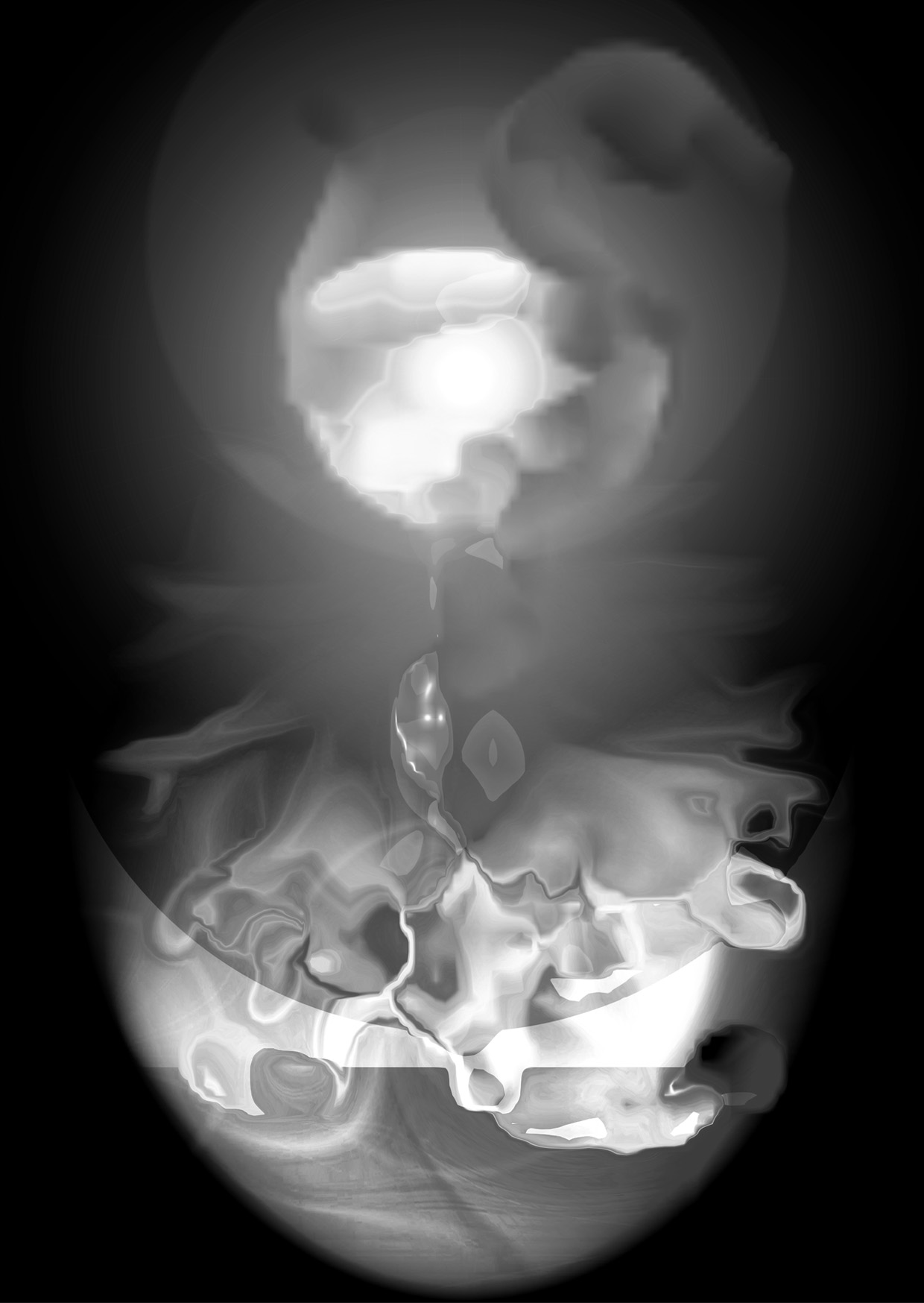
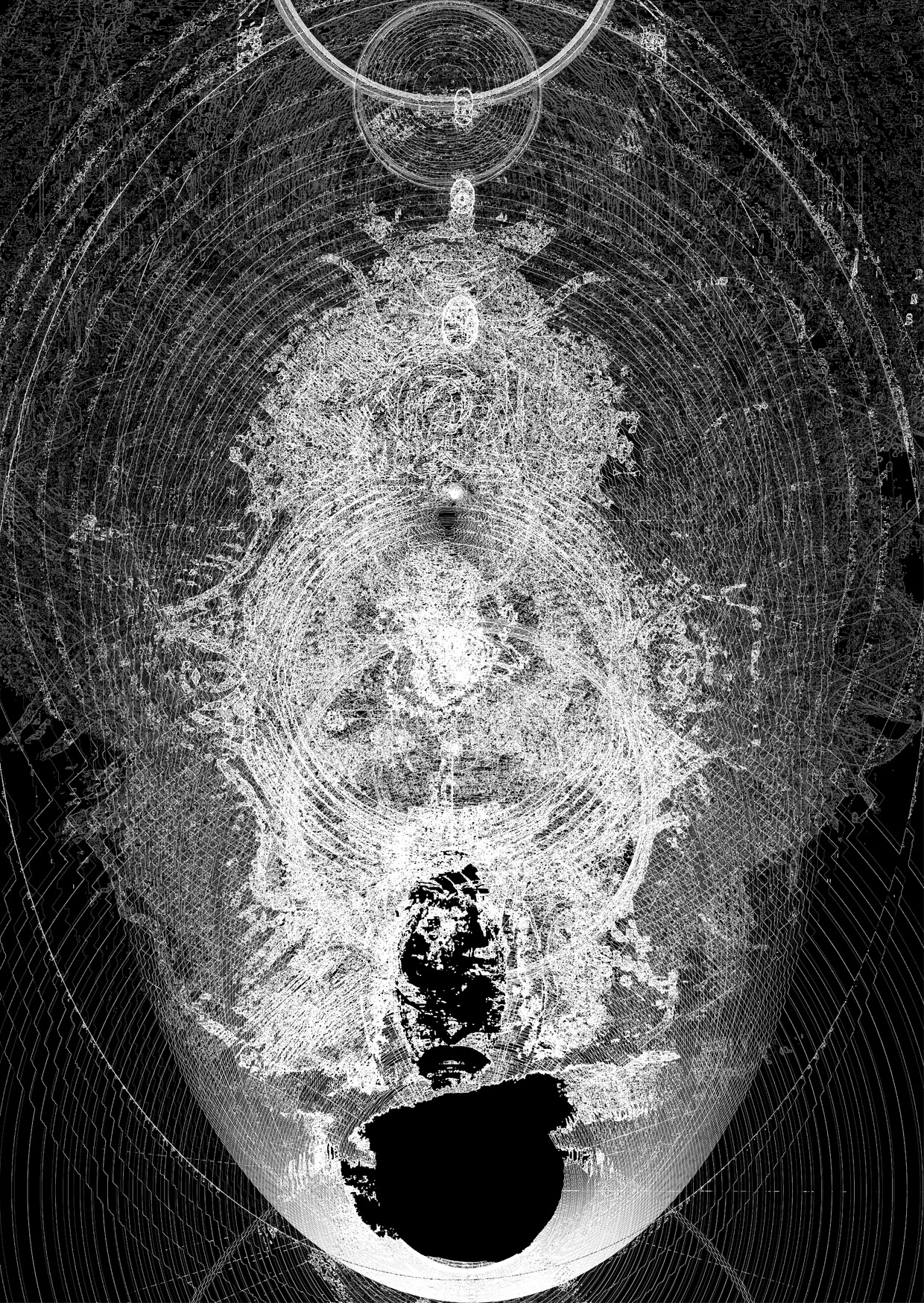
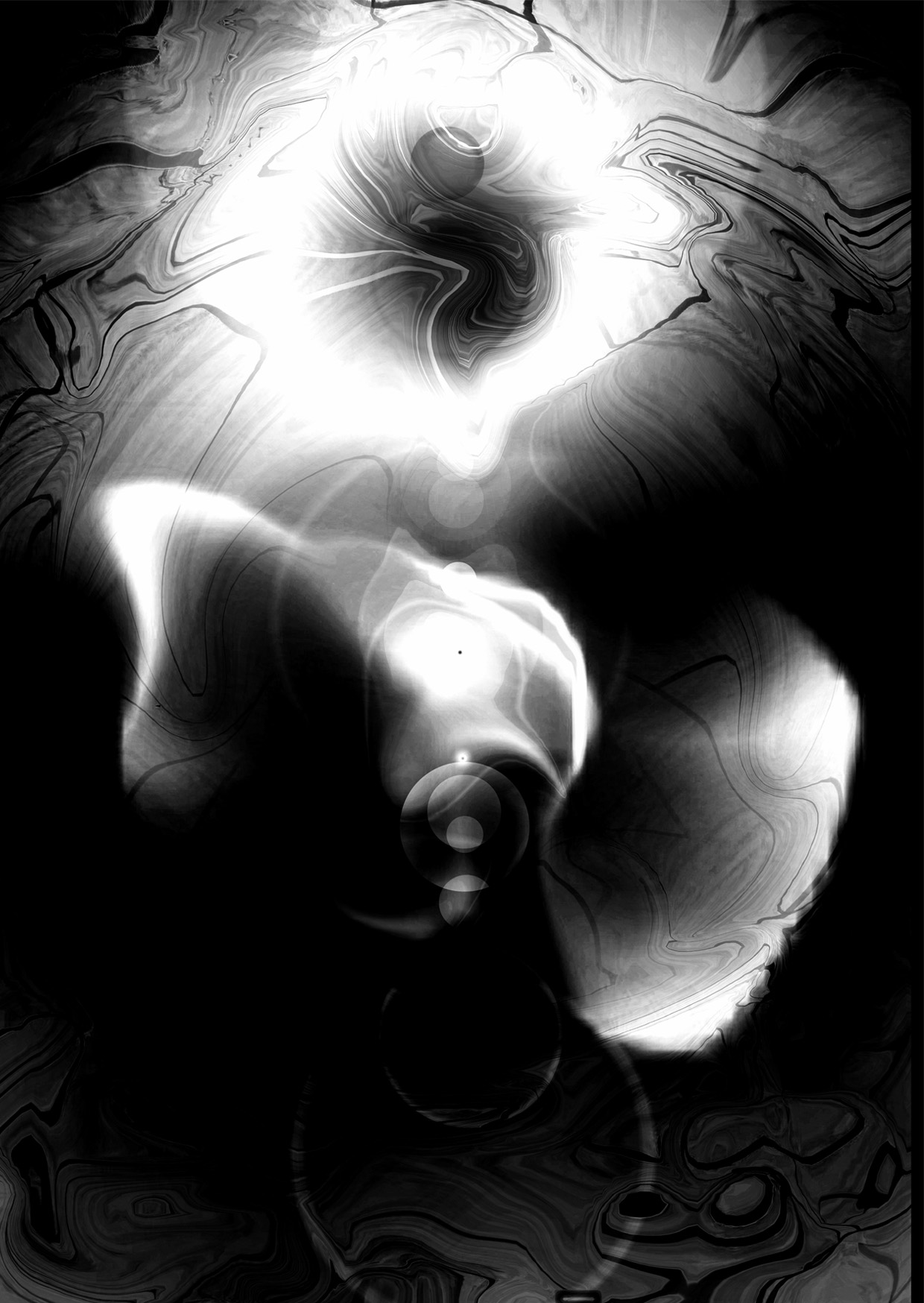
Yesterday evening I was playing around with images for the cover of said, slim volume. Getting into the flow, I was revisiting a couple of colour prints, modifying them for a dramatic black and white. Happily, it turned into a potential project all of its own ( or at least so it seemed in the fever of creation). A sort of abstracted yantra meets medieval woodcut, chats with Blake on angels and ghosts, then nods at the engravings of Gustave Dore ( he with the appropriate accent), with a reminiscence of Book of Lambspring and alchemical doings. Possibly a way of illustrating words on the Mahavidya goddesses. Hence the circling of subjects, the orbit of words, that follows:

MOONLIGHT THROUGH GLASS

Moonlight through glass:

Solve et coagula

Dissolve and solidify.

Resting in silence

A vapour of thought

A mist of emotion

Twin mystery

( two of too many):

Light and orbit.

Something fast as infinity

Slows through a lens

Of liquid sand;

Something as unconcerned

And chaste, a satellite

Held gazing face to face,

A waltz of gravity.

Taking form, giving name, chasing thought.

Dance of equations, conjuration of stillness.

Simulation of solidity, (vibrating nothingness).

To give meaning,

To build a path in a pathless wasteland

(suddenly goals, suddenly distinctions)

Mirroring, reflecting, perhaps, the definition of our purpose.

Narcissus has become our jealous god

(echo lost, echo found).

Dancing round the fire,

Oh, we know that one’s name

That will spin gold for us

(though he will still trick us in the end).

And why, why, do we honour Prometheus,

That medler who ruined more than his own prospects,

Who brought down much more than fire upon us?

Too smart for your own good,

Answers too shiny-

Clear-cut, obvious, too self-serving,

Too monstrously elegant.

Ferment.

Closed system

Athanor.

One strong enough to withold,

To withstand all turmoil,

A roiling of opposites.

Not designed for madness

But madness is where we all must go.

The madness of too much,

The madness of not enough.

An incontinent ejaculation,

White noise, staining silence,

An endless slurry of love songs,

A loop of imprisonment.

Ferment.

The numbness of moonlight –

Passion stilled within the heart.

Whitened. Blackened. Consummated.

Brought forth.

Soot-faced puffers

Strainng to wriggle free.

Moonlight through glass:

The achievement,

The surrender,

The transcendence.

—–

A6BW cover11

And not too dissimilar ( the metaphysics of stellar cosmogenesis, of electromagnetic emotions), words orbiting the bright imagery, the dark, powerful, inhumanly human goddesses, Ten Nights of Transcendent Darkness, Objects of Transcendent Wisdom, Mahavidya Goddesses. This one the aspect known as Tara ( Second Night of Hunger).

TARA: SECOND NIGHT OF HUNGER

Tara, Tara,

Hungry star,

Unquenchable yearning.

Infinite distance

Is the path to return by.

Light from the farthest edge

Wishing to return to your comforting blackness.

Consumed, conjoined, united,

Undifferentiated,

Possession of belonging,

Lines of gravitational force.

That which separates,

That which holds together,

And beyond all these,

The desire for so much more,

The desire for so much less.

——

A6BW cover29

For the clearest, and certainly the most poetical and image-rich words, concerning the Mahavidyas I would recommend Alain Danielou’s great work “Hindu Polytheism” ( that majestic title now sadly pedestrianised to “The Myths and Gods of India” ).