Feeds:
Posts
Comments

Posts Tagged ‘landscape’

P1100720.JPG

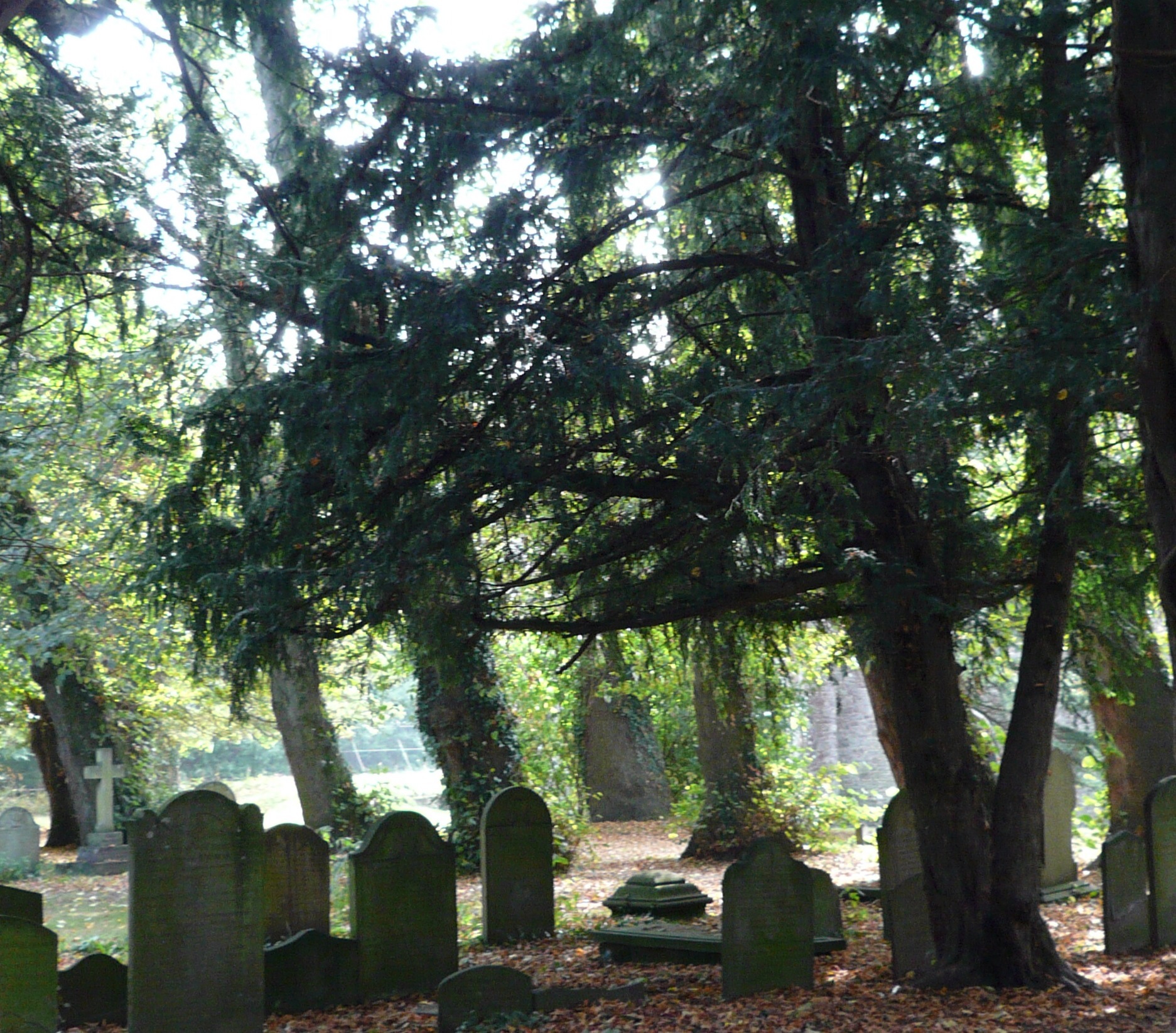
On the edge of the Brecon Beacons in mid Wales, Myddfai has long been associated with traditional herbal medicines. The story goes that a young farmer in the 13th c. was passing by small lake in the mountains above the village and fell in love with a fairy girl, the Lady of the Lake. Their descendents were renowned for centuries as herbalists. The line died out in the 18th century and are buried in Myddfai churchyard.

WITH THE YEWS OF MYDDFAI

Walking amongst the dead,
With the yews of Myddfai,
(And are we not always with them?
The left and the lost,
As they are with us always,
Whispers breathing cool).
Ground ivy sweet underfoot,
Plantain fragrant above their heads,
The soft, springing grasses.

Taken up, become trees,
Corded limb and leaf.
Holly, cherry, elder all
And the certain hope of yew,
Candle eternal, resurrected
On cross-beams of utter time.

Trees of blood, names forgot
Yet the throb of heart and cell
Pushing out from one likeness
Into a congregation of small sacraments,
(A blessing of toes and fingers
And round, pursed mouths,
An O, a cup, a small, red, sweet seed).

Trees of name and trees of memory.
A date of birth and a date of decease,
Only a short, curved line between
To measure each coming and going.
A start and an end,
A retrieval of mythology,
A reinterpretation of dreaming.
Thin lines of light,
Delicate mycelial wanderings,
Sole nutrient of futures
In sunless soil and sinless light.

A tangled commonwealth,
A last, shared supper.
The weeds of healing
Melting and rising upwards.
In late sun, (October now),
The wood is warm to touch.
Take time,
We say,
But they leave time alone
And live beyond our means.
We, with borrowed flesh and borrowed light,
Who give it all back
(Willing or unwilling),
To be born again,
To be built into another time,
Another place.
Vessels pouring into vessels,
A fall into grace.

P1100725.JPG

Read Full Post »

LITTLE LLANGAMMARCH

Little Llangammarch under wood and under hill.
Not quite awake, not quite asleep,
Dreaming as leaves drift down.
One road, more or less, one shop, one bar, one hall,
A church, a chapel or two.
Time each day measured by two trains north, two trains south.

Toes wriggling always in Irfon and Cammarch,
(Where the two are met and knitted, a feathered mating).
Root or rock, I cannot say for sure.
This stone sheds syllables in flakes,
Prayers slurred, folded, forgot.
This root, iron red, waves wrapped,
Unworn, unmoved, on the hill above,
A saint’s house, stilled glory, skybound.

The swoop and quiver of the red kite’s call.
Shade-huddled sheep, the quiet of the field.
The past it grows thinner by the year
Lost for words, the long losing of names,
The who and where, the why weeded over,
The hero’s house, a longed-for truth
Scattered in byre and farmyard.

Between the open-eyed houses
and the river, still and low as glass,
Come tumbling flocks from the fields,
Down between the cars a bleating tide,
Chivvied, the bobbing, weaving dogs behind.

It hovers: the mountain silence.
They come and go of their own accord,
Leaving clouds and mist for a while, for a while,
Between what is left unsaid
And the slow rain.

Here below, where woodpeckers cling statuesque
and jackdaws skid and race
Like kids in playgrounds, cops and robbers,
Shootout at noon.
Here, in the fields again
The sheep wander as numerous as stars and as white.
The wind blows colour and light,
To and from the bluffs of Abergwesyn.
The rolling darkness, the quiet night descending
From the deep well of Cwm Graig Ddu.

Read Full Post »

IMG_1139.JPG

BRECON CATHEDRAL YEW WOOD

Dappled, the dead sleep
A slow, chimed crumbling.
A choir, a roof, are these yews.
Riven and sundered, tied back and bound,
Reworked, ribbed, buttressed.
They stand between the leaning,
Between the soaring: the lime,
The cedar, archangel sequoia –
All elders singing before the throne.
A hymn of jackdaw and blackbirds,
An antiphon of ivy dust.
Time riding heavenwards by degree,
Folded and sealed,
A shrouded, deeper silence.

IMG_1135.JPG

Read Full Post »

THE ROAD TO LLYN BRIANNE

There are,
There upon the turning road,
Great stones that watch
Without eyes,
Deep gullies with secrets
But no guilt,
A green, lined knotting,
A measurement of altitudes,
A satisfaction of soughing,
Where the treetops pin cloud
And the loud, round thin
Cry of hawks
And the surprising gorse
And the dusty heather.

At this height
The still, silent, drowning waters
Are steel half polished,
The vowels of ice and aeons
Carved into old valleys
And the grey, cracked rocks
Peer out shaping wind and runnel,
A shelter for moss
And little things hardly cared for.

They are persistently hopeful:
These lone fishers for gold,
Generators purring
Sifting the blood of old mountains,
The dust of suns.

And the sheep
Nonchalent as philosophers,
And the swoop of druid crows
On the diving road,
Where distance is down.
The world curved
And marvellous.

Crisp, cusped,
Drunk on vast views,
Descending at last,
A road less laboured
Between blanketed green,
Behedged, somewhat planned,
The roll into town,
A reassertion of time
Into space.

Read Full Post »

LLYM AWEL ( part 2 )

Llym awel, llum brin, anhaut caffael clid;
Llicrid rid, reuhid llin;
Ry seiw gur ar vn conin.

The second phrase is ” llum brin” , “bleak hill”.
Jackson makes it ‘bare the hill’. My iTranslate prefers ‘bleak’.
The choice of synonyms are many and subtly divergent: bare, desolate, hostile, barren, are all covered by ‘bleak’, whereas ‘bare’ seems to me a thinner meaning, and confusable with ‘naked’, thus making the association physically personal, rather than the ferociously and unconcernedly unsympathetic ‘bleak’.
At this stage in the poem the poet has just drawn a landscape and inferred from the adjectives (sharp, bleak) a human presence. The final phrase of the line is ‘anhaut caffael clid’ ‘difficult to find/to obtain/have shelter’, implying he/we are out in this harsh weather.
As this is the case, I wonder whether ‘llum brin’ should be read as ‘this bleak hill’, or ‘bleak hilltop’, because we are not to view it as something out there at a distance, but something here below our feet, all around us, because it is out on the exposed hilltop that we would want to find shelter from the elements.

“Sharp breeze, bleak hilltop, difficult it is to obtain shelter”

There is a contrast in the two halves of the line between the impersonal elemental world, and a small human being moving,uncomfortable, through it. In the Welsh, the first two phrases glide and tumble, compared to the jerking, hesitency of the last three words.
The next line resumes the echoing, reflecting alliteration:

“Llicrid rid, reuhid llin;”

and also returns to observations of the seen world: ‘Llicrid rid’ , Jackson translates as ‘The ford is marred’. There is a sense in ‘llicrid’ of pollution, contamination, become fouled. Presumably the weather conditions have destroyed the gentle, smooth crossing place. I have settled on ‘churned up’ to give that sense of disorder and chaos. This then nicely contrasts with the following phrase: ‘reuhid llin’, lake freezes. Slight variations will give a different taste. Jackson translates this line as ‘ the ford is marred, the lake freezes’, but I feel this distances the experience and makes it rather general, something that happens each winter, not something that is causing an immediate emotional reaction in the poet at this moment, on this journey.

‘The ford is churned up, the lake frozen’

These two phrases contrast each other in the same way that wind/ breeze is active and hilltop is motionless. Here the ford has become wrecked and flooded where it is usually calm, and the gentle rippling lake has become motionless and still.
In Celtic worldviews ( even as a continuation from the Bronze Age) both fords and lakes were sacred as gateways to the Otherworld, liminal places to access the spiritual. Here, they can no longer serve that function – the poet feels even more isolated from the succour of the spirit worlds ( and so giving another meaning to ‘difficult to find shelter’).

The last line is:

‘Ry seiw gur ar vn conin.’

‘Ry seiw’ is “it is (even) possible to stand”, gur/gŵr is ‘a man’, ar is ‘on’, vn/un conin is ‘one stalk/grass/reed’

So: it is possible to stand a man on one reed
It is possible for a man to stand on one reed.
A man might stand on a single reed.

Jackson says: ” A man could stand on a single stalk” , which has a nice quality of flow and wonder to it. To my eye, a ‘stalk’ can be too easily visualised as lying flat on the ground, whereas a reed maintains its sense of verticality, and has a more proverbial sound to it.
Nicola Jacobs’ commentary explains this line as meaning the reed/grass is so frozen, so hard that it can be (theoretically) balanced on. But it also suggests a man made hollow by care and hunger, so light, so worn away and insubstantial, that a reed would not bend under his weight.

The ‘sharp breeze’ of the first phrase is echoed by the sharp, blade-like reed of the last, both summing up the discomfort of the season.

I will mull these ideas and work on my interpretation……

IMPROVISATIONS ON LLYM AWEL

Sharp beeeze, bleak hilltop, difficult it is to obtain shelter.
The ford is churned up, the lake frozen.
A man might stand on a single reed.

Splinter cold, breath stolen.
Pummelled, stripped, this ice wind.

Desolate my road, this dead, domed hill,
Rotted brown and wan.

Shelterless, this way or that,
Remorseless the trudge, and dismal.

Every ford is ice mud,
Churned by all the cattle of the world,
Cast, charnel, sullied, broken.

No joyous lake,
No light waved, rippled,
No meek lap nor song.
All iron ice, white and burning stillness.

Worn hollow by winter,
Wormed and wrought, ringed out.
I wince from every blade of it.
Reeds rattle underfoot.
Pierced, I am lost amongst grasses,
Harsh-throated, severed from home.

—-

Read Full Post »

LLYM AWEL ( part1)

Llym awel, llum brin
Anhaut caffael clid
Llicrid rid, reuhid llin,
Ry seiw gur ar vn conin.

This long sequence of ancient Welsh verse is named from its first phrase. I was curious to see if I could use some of these words in my artworks. There is a magnetic mystery in words on the horizon of understanding, whether because the language is very old or because it is unknown. Language freed in this way from meaning turns into the music of rhythm and the shape of the mouth. Language is a vessel of sound. Meaning is what fills that shape up in some way. But meaning is not one thing. These gnomic verses, like much ancient poetry, is terse and ambiguous. Translate one way and it carries a completely different mood from translating another way. After all, vocabulary is not meaning. Language builds a picture in the reader/hearer’s mind, and because it is created by another human, it carries its own emotional energy, which may or may not be transmitted whole. Language is translation of a unique experience by and for another. Translation from one language to another first of all loses the implicit rhythms of the original language, and then it often misplaces some of the original emotional intent by a less than perfect matching of word meanings.

‘Llym awel’ seems to be generally translated as ‘sharp wind’, but this itself is a metaphor. Wind does not cut, nor bite, gnaw or pierce. It has no teeth and no sharp edges. The wind, ( if it is wind), is to be perceived through our physical experience. That is what is transferred ( or not) in the meaning. I cannot speak Welsh, neither modern nor Medieval. I have relied in this investigation on accepted academic translations, commentaries and the automatic translations of modern computer programmes. All these provide different viewpoints from whence the original genuine emotional might be unearthed, or else an interesting improvised variation might grow.
Most words have synonyms. Poetry relies often on these to select appropriate metre and rhyme. Bardic Welsh poetry is hugely complex in its internal structure, playing with sounds all the time, following convoluted rules and templates. Translation cannot hope to match any of this well. Poetic commentary and improvised variations may be the best way to approach the feel of the original material, without pretending it translates word for word…..

The first query I came across was the meaning of ‘awel’. My translator insisted on ‘breeze’, giving a completely different word ( in modern Welsh) for ‘wind’. Now the feel and mood of ‘wind’ and ‘breeze’ are very different. So too, ‘llym’ was given as ‘sharp’, ‘ keen’, ‘acute’ – all of related meanings but all with very different emotional energy.
Language relies heavily on habitual idiom and familiar metaphors. We do not question ‘sharp wind’ because we understand that this is not a literal, objective statement. Literal meaning slur and smudge in the creation of a mental picture. By practice we learn to understand when familar phrases mean something rather different. This somewhat complacent use of language is often very different from the meticulous choice of the skilled bard and poet, so it is important not to fall into using the blurred edges of familiar idiomatic phrasing when it can distort or disguise the precise clarity intended by the poet.

We all pass over ‘sharp wind’ very quickly. We get the general drift of meaning, the flavour, but ‘sharp breeze’ makes us pause and reconstruct. It is at once less usual, and a much more particular equation. A breeze is not a buffeting force. It is more akin to an occassional breath. A more harmless movement of air. So when this gentle, slight thing is felt as ‘sharp’ or ‘keen’, then we can automatically readjust the experience. How cold must the air be, for even a slight breeze to cut through to the skin?

So my commentaries and improvisations on these two words were:

Llym awel,
Sharp breeze,
This small stirring drains warmth,
Negates clothing.
Breath breeze makes cold colder.
This breeze breathes ice.

Read Full Post »

IMG_1107.JPG

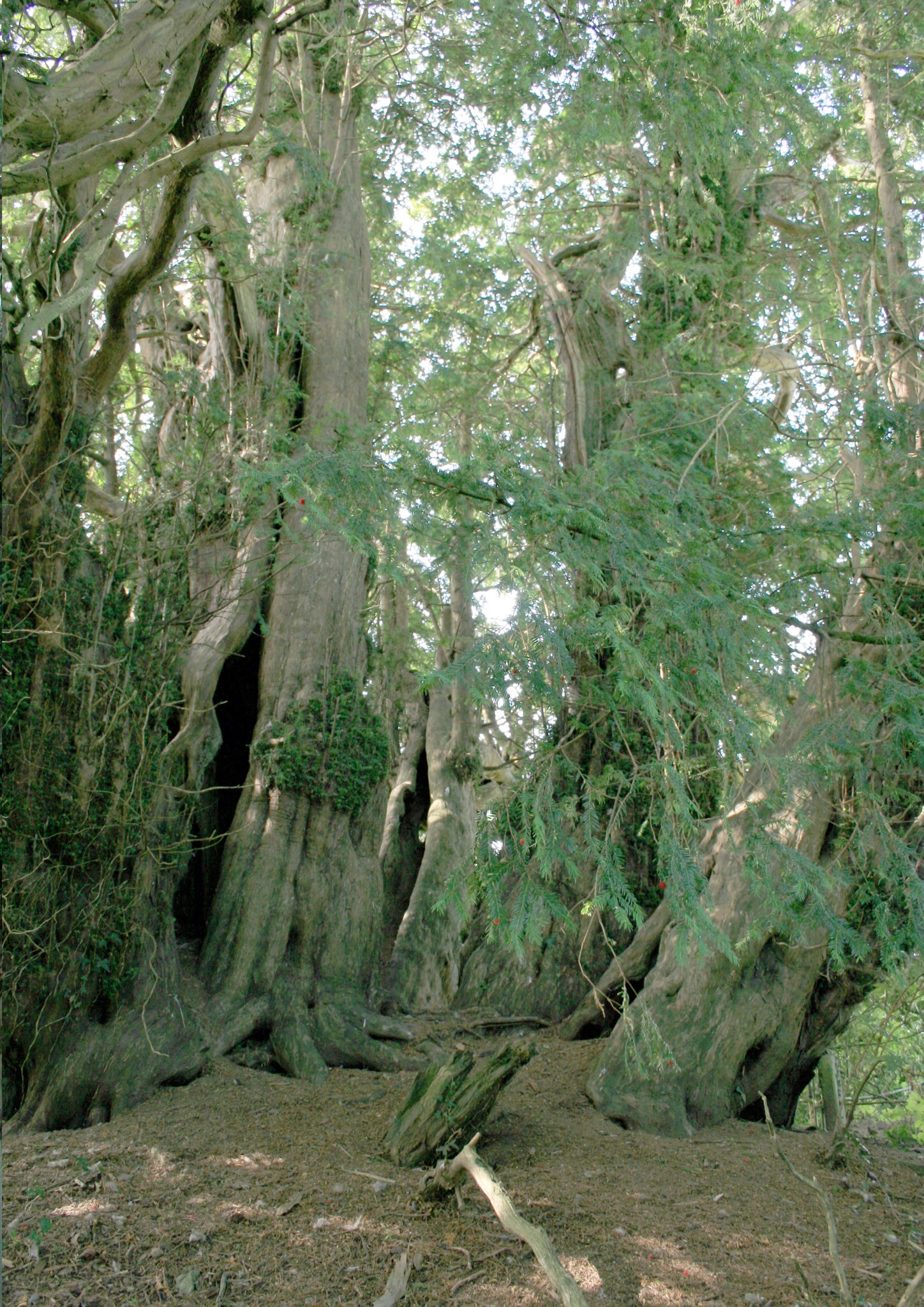
YEW GROVE AT LLANAFAN FAWR

1
Light sensible, thick as darkness
And light veiled, filtering downwards.

One red cup, one seed dropped,
Rippled out, measured by millenia.
A ring of sinew trunks, weighted, poised.

2
Where the old road
Cups the round, green breast
Of Llanafan Fawr.

Where the quiet mound
Floats above the heads of valley oaks
(Distant voice of rock-sided Chwefri).

Where the dead bask in sun,
Sleep in shade,
Their names carefully chiselled,
Painted, kissed in lichen.

3
Rising up
From the Underworld
Where the dead become stars,
Where bones multiply,
Where dreams are born
And shadows grow their own souls.
There, the umbilical roots
Bind light to darkness
Making song
That wheels this world.

4
Fed by scintillating constellations,
A certain, mutual apotheosis,
A rippling out of layered years
Laid down in sinuous orbits,
A hug of dimensions,
A vessel for longevity, for remaining.
Only holding on.
Only breathing.
A mirror from each metalled yuga,
Withstanding heaven’s gobby adolescence.

5
Three great props to prop the sky.
As the gods choose their own forms
Grown from curse and pleadings,
From a universal need, the deepest science
Of leaning upon
They have measured up,
Filled the matrices,
Solved the quadratic and the algebraic,
Judged the swing of planetary orbit.
Readjustments made, reconfiguring
A weighty gravitation,
Collapse, expand, spin.
(Those three doors all life dances through)

6
Old before the brazen, gaudy eagles
Meticulously trampled lands not theirs
To glut the slovenly cities of the South.

Old before the contrivance of contorted guilt,
The crosses to be borne or cast away,
The ring of truth, the hope of doves.

Old before the King of the North and his kin
Bred saints amongst sacred hills.
Before Dewi and Afan, (who, maybe,
Were as eloquent as uncle Taliesin),
Sheltered wise candles from the wild storms:
The slick guttering stroke of marauding steel,
Thud and groan and a pouring out of life
In a red gush, anguished and final, among the silent trees.

Old as the penetration of water through rock,
The endless drip to sunless oceans below,
Is the strife of men, the lamentation of their women.

Old, and the richest of composts.
The most intricate of tallies,
A long genealogy, a swirl of lusts.
All commingled, compressed, considered,
All fit and meet, an elevated sight,
A blossoming of poison and beauty,
A perfect circle, a sunlit ripple.
One tree is a forest,
One grove a memorial
To these thousand thousand lives,
Drawn up, drawn in,
Held, encompassed.

—-

IMG_1101.JPG

IMG_1102.JPG

Read Full Post »

YEW AT LLANYMDDYFRI

I am a fire banked up.
No loud voice
No chanted, righteous psalms,
No holy threats.
Quietly I suck the dead,
Draw from what they no longer need.
Green leaves and slow, dark sap.
A skein of green dressed in veils of ivy.

Not large, not small,
I go on regarding, regardless.
My hymns are quiet,
A gravity for time and space
To dance around.

Disregard me.
I am as undistinguished
As you shall be
As you fall forgotten
Mixed with mud and misty memories.
But I shall see days you shall never know.

A stone’s throw from eternity’s grey walls.
Lived in by wrens, lived in by blackbirds,
Priest and brown sexton.
Banked up against the long hill,
The green valley cowled and shaded,
A cave for meditations.

IMG_1071.JPG

Read Full Post »

IMG_1073.JPG

An attempt at translation from English into Welsh using iTranslate. Some words were altered to find correlates – it didn’t like ‘held’, ‘unbelonged’, ‘lorn’, ‘furled’. I would welcome any comments from Welsh speakers- apart from a few words that I recognise, I do not know how well the software has worked, but would be interested in finding out how close or far from the mark it is!

Sleepless, I must wait
Tight-wrapped,
Held white and unresolved,
Dissolving,
An unbelonged thing.

Di-gwsg,
rhaid i mi aros
Dynn-lapio,
Cipio gwyn a heb eu datrys,
Diddymu,
A beth nad ydynt yn perthyn.

Wait, and I shall meet you
Down by the bridge, by the ford.
Where the river always murmurs sense.
In twilight, in evening,
Furled suspended time,
Honeysuckle warm
And the whisper of moths.

Arhoswch, a byddaf yn cwrdd â chi
i lawr ger y bont, gan y rhyd.
Lle mae’r afon bob amser yn si synnwyr,
Yn cyfnos, yn y nos.
Amser plygu atal dros dro,
Gwyddfid cynnes
A sibrwd o wyfynod.

But lorn I am
On this longest shore.
White, cold white, the horizon.
The far breakers’ withdrawn roar
Leaving naked the still, black rocks,
A salt taste of wheeling gulls.
A spun void.

Ond gwan wyf
Ar y lan hiraf.
Gwyn, gwyn oer yw’r gorwel.
Rhuo Mae’r torwyr bell ‘tynnu’n ôl
Gadael noeth y dal, creigiau du,
Blas halen o gwylanod gwthio.
Mae gwagle nyddu.

—-

IMG_1046.JPG

Read Full Post »

LLANHIFANGEL ABERGWESYN

IMG_1079.JPG

Heather, royally purple, clothing the hillsides above.
Around the circles of Llanhifangel Abergwesyn,
The silver, sanding shores of Irfon, curved and rippled.

Sheltered from sheep, this round silent shield
Is where they are gathered, where they are splintered,
Where they are woven.

United, divided, leaning into the storms of Time.
Hausers swinging between centuries
Binding sun and earth, to heaven, even.

Knitted light revolved and spun,
Wheels in wheels, a thousand eyes
Open and closing, a blink of orbital rhythm.

These trees, these towers, these castles roaring upwards.
Ladders of chant and silence,
Spilt shade.

Bow ye down,
Bow ye graceful between the gravestones,
Flaked and moss green.

Bone and mind incorporate,
Reawoke, voiceless and benign
In speckled sunlight, sublime.

IMG_1077.JPG

Read Full Post »

« Newer Posts - Older Posts »