Feeds:
Posts
Comments

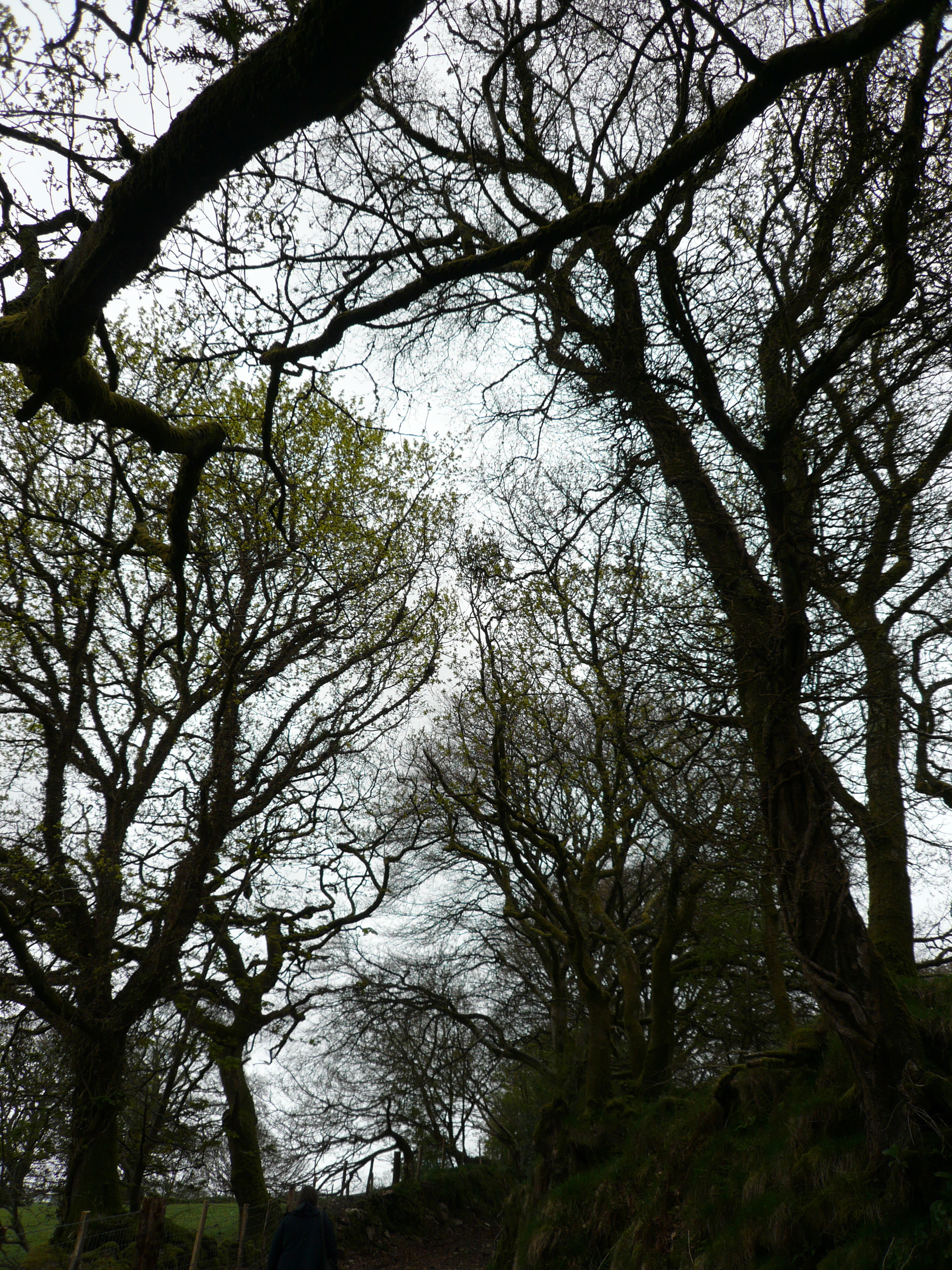
Ty Canol Wood

TY CANOL WOOD

It is a narrow house, the wood that is made for eternity.

A smoke of dream shivering upwards into air.

The roots of it smoulder below, flame-leaves lick.

It is a narrow house we are born into.

So much that cannot be reached, cannot be known.

The paths wander between moss boulders and broken bedrock,

clothed in thick green life.

Constrained by thin earth, yet they all do seem to dance,

and at night, some say, they walk

and the rock creaks open,

light spilling from golden halls,

and that unnerving perfect music, too.

A narrow road and a narrow house we have set ourselves,

But that is not the world’s way.

She dances and throws it all away in broad gesture,

Sings at the central hearth, though no-one listens much,

and knows that song is food for every soul.

Feels the billowing thunder head, this haze of gnats,

the invisible silver threads beneath,

and the chains of finest gold,

and the footprints of old gods between the stars,

that is birdsong here

in Ty Canol Wood.

—

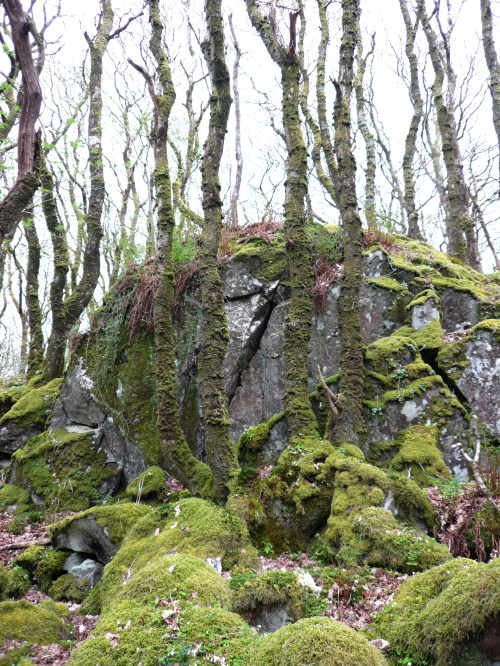
This ancient small woodland in Pembrokeshire is named from the nearby house, Ty Canol, ( the central, middle, house). It has links to Otherworld inhabitants, and has a definitely magical atmosphere. Here I am contrasting the open, generous quality of the natural world with the restricted experience of mortality and human perception. The coffin is sometimes traditionally referred to as a narrow house and the tomb to a house of earth.
Archetypal

ARCHETYPAL

The hunter father transgresses;

The mother suffers unjustly;

The child is taken.

What was wonderful, vanishes.

The light disappears, no one knows where.

Roads, veils and mirrors –

The mechanics of universal dance,

The momentous, minuscule choice.

The bright, eternal child brought low,

Brought back to the wrist of the falconer,

Brought back to rule in glory,

Brought back to catch the uncatchable.

And all the time

It is she that saves the day,

Who bestows and restores balance,

Who names, who summons, who moves

Like a moon through darkness

Sorrowful and joyful and blissfully full.

And the child, neither here nor there,

Neither this nor that,

Tricked by innocence

To reveal the weakness,

To discover an impossible death,

To wait endlessly in the wings

For the lines of the last act,

The resolution.

I ask to know the truth

So that there may be understanding of power.

That the maps are unfolded

And the well-trod, invisible roads revealed.

Because we are free only to follow the well-worn ways,

Because there is only one plot and one story

From the beginning.

Because, tried and tested are the grey chains.

Because, tried and tested is the only freedom.

The rules of falling, and of redemption.

—

THERE, THE STILLNESS SINGS

sink down a little, beneath these surfaces.

the same world, a different view.

a cool wind is blowing, though the mists stay still.

the deep hills in the north, the uplands of the south

are nowhere to be seen.

in the garden scented rose petals drop like rain.

sink down and find the earth,

a rich soil of dreaming.

my souls have coalesced

but drift apart as stars do,

As wandering flocks do.

without even trying

the hills begin to emerge.

it will be a hot day

and we shall be grateful for shade.

—

First Lesson

FIRST LESSON

You will have been wandering, I suppose,

Through the sunny, vague landscapes of your life

Following the habitual hounds of thought

Weaving in and out your thoughts.

.

You will have come across these words,

Sucking them up, making them yours

Before even thinking, before even thinking,

To whom do they belong? Whose voice, now?

.

We believe ourselves sovereign here:

My mind, my territory, my dwelling place.

But is that really so? (is what I ask.)

You have wandered into other worlds

Oblivious of boundaries, so hungry for more,

So sure of what is.

In an instant, becoming something else

( a folded, entangled irony, to enjoy all the horror movie themes).

.

A skin not yours adheres,

So you become something you were not.

What we do, we become.

What we take in, becoming our responsibility.

.

Shimmering are the edges of the world.

Mirrors and doorways are everywhere.

Names are roles and speech

Sets about great tidal shifts.

.

You know what you know now

By becoming what you were not.

A communion of voices.

—

Epynt Songs

WAR HAS CAST THEM

War has cast them off the mountain

And they have never yet returned

Except their tattered ghosts minding flocks

And the wind and the rain and the ravens.

The stone, green under soil.

The soil, black under sedge.

The distance sailing above cloud

Shaped by worlds beyond reach,

Reciting the names, reciting the names.

—

SOME GO

They weave these times of plague

with threads of brighter days.

Sharing the names of farms and families:

Nain, hen nain, hen hen nain,

and the tales of the tales she told.

The hearths swept and re-laid

for an eventual return

after the storms of the world blow by;

the family bible left open at Lamentations.

Some go into the hills,

finding the silent walls

moss green, wide strewn;

the signs all but lost,

like the songs of living and dying:

the songs of harvest, the songs of planting,

the songs of weaving, the songs of lamenting,

the songs of losing and of finding.

It is the songs of living

that we have lost forever;

the songs of simple doing

that told us we were not alone

in feeling the rhythms of breath

as muscles worked and tasks completed.

It is all silent in the hills now.

cloud and curlew,

raven and lark.

Memories fade

as the farmhouse walls

tumble under moss.

Hold on to the names,

the farms, the families,

the cherished dead.

Over their heads

the world changes.

Plague days,

words dying.

—

The Epynt is an area of high uplands between the Brecon Beacons and the Cambrian Mountains in Mid Wales. A strong, rural, Welsh speaking area, the Epynt was cleared of people at the start of the Second World War so that the land could become an artillery training area. Eighty farms were given a few months to pack up and leave, breaking and dispersing a robust culture to find their own way miles away from their homes. After eighty years the land is still possessed by the government and this year many descendents have got together to remember their families, where they lived, where they moved, who remembers tales of the old days.

I take my instruction from rivers,

My constancy from the weather.

I endlessly catalogue shadows by their song

And tremble before cracked mirrors.

It seems I fear endings more that anything else,

And the golden dust of victory’s wings.

This debris I accumulate for oracles,

And read meaning into what has gone.

The light of life is an unbearable weight,

Longing so long for irresponsibility.

Silence ye your ghosts

So that you might hear a simpler melody.

You are a moment’s dust gathered

Around each slow breath.

Savour stillness.

There is no war other than this.

Stretched between joy and sorrow

Is where you grow strong.

Attaining emptiness

The world can fill and empty

And fill again.

—

Raag Megh

RAAG MEGH

find the

slow rituals

that absorb time and space.

.

there is

no hurry,

words vanish, yet

last forever, somehow.

.

the green, warm rains

as soothing as music, fill

the breathing valley.

.

one step

is all it takes

to start a dance

no-one has seen before.

.

we will, for sure,

be swept up in

sadness and joy.

.

we will, for sure,

be persuaded that beauty

is just not enough.

.

slow air pushes

the thin rope of smoke

to and fro by the window.

veils of rain hide the hills.

.

it is green and cool and lovely,

the trees say.

look at our slow dance,

they say.

.

and let go

their tired leaves.

–

Raag megh is a pentatonic raag (raga) played during the rainy season, but because of its cooling, calming influence is also played at any time and circumstance. i used it as the name of this poem as it seemed to fit its atmosphere and mood. Check out raag megh on youtube, especially those by ustad rashid khan, pandit jasraj and kushal dass.

Faint Breezes

FAINT BREEZES

Faint eternal breezes between stars

Where the gods have walked.

.

The door-hinge between worlds screams

And time is changed. Your names are of no value here,

Nor your skills.

.

Your future has been stolen

Because the past was not understood.

.

All roads dissolve at the misty edges.

This forest is your accuser.

This forest is your river.

.

The dance between two and three,

The vanishing one eclipsed.

Umbra, penumbra, chorus, echo.

.

The table of utter silence.

The taste of grey iron chain,

Grey as morning, neither this nor that.

.

Four stories long the seamstress works,

Head bowed in patterns, the needles

Darting in and out.

.

Blake and Burne-Jones naked on the shore,

Collecting the teeth of dragons,

Barefoot in embers and sea wrack.

.

The sky boat reflected in the moving waters,

The stallions hobbled, too wild, even, for war.

.

It is the gentle who are moulded

For vengeance and bleak reply.

.

And still the future is mute but growing.

It will be bright with accident,

Possessed with skills of no use whatsoever –

The arts of distraction and decay,

The sowing of grief and duty.

.

Do not look for any meaning in the words ( they say)

The key is not the door.

There is no lie in winter.

—

Viscum album (mistletoe)

From the druid vision it creeps through neural caverns back to the arc of ancestral voices

In the dark lodge of backbrain, the spine tree, which, from there the roots of the tongue,

Fire it forwards boiled by breath in the cauldron of the mouth.

It emerges complete, an ejected god-form brilliantly swathed, a gold-pinned cloak.

A body of light this beast has become, from wild to wise, from wrathful to illumined.

.

From whence do we grow?

Not from the left leaf, nor the right leaf, but from the point in between.

We grow from the dividing point, from neither and from nor,

Balanced and hefted the spear of green life thrusts deep into the dark secret of the world

And becomes born.

.

So thus, mould the dark to ferment the light.

The dark muscle fires the star blood.

The poison well, the poison cauldron,

That is the only place to distil wisdom.

As the youth ejaculates deep into the warm folded love of his girl,

As the tongue searches each grunt and scream for music and rhyme,

The light will not come forth because it has goodness.

It must have fuel to burn: some dark slick greasy remains,

The blubber and wrack of melted lives,

The dancing skeleton god breaking bones and sucking marrow.

.

He is not a druid who knows not this.

He is not a man of skill who does not refine the ore of remembering,

Who does not balance the two ways and find the third and only way

Through pain and despair to a steady roaring bright flame of light.

—

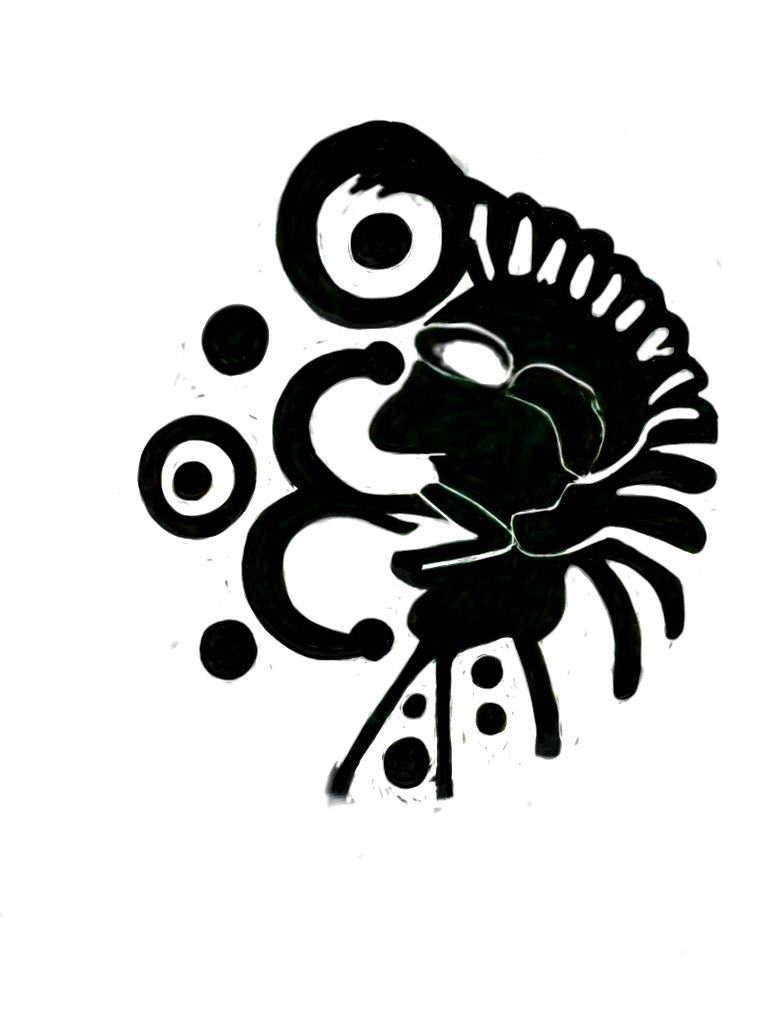
This is the third and last piece based on the image below, which is from a Celtic coin. The words were explorations to find meaning for the strange and powerful imagery. In this part, the resemblance of the motif coming out of the mouth to those that appear in other coin designs suggest it might be a form of mistletoe, or at least, the sacred tree of which mistletoe might be an archetype.

A Fall of Kings

A FALL OF KINGS

Crow! Crow! I can hear your voice across the valley,

keening and laughing, looking for your shadow

in the sunlight.

The heart may break into pieces

but the head will still go on nattering.

It can never stop, so used

to being fed by roots and wings

from its buried pit, from its damp, deep well.

It summons up and sees what there is and what is not.

.

A dying comet streaks beauty in the slowest of motions,

upright as a ballerina melted by the music –

Posed and poised, palest and vanishing,

though here, still here, in the dawn light.

.

A voice like last night’s river

hidden in the oak valley,

down by the alders

down by the willows

in their midnight silences.

.

A voice like the morning road

across the valley side,

the streams of bright hope

rolling with ridiculous purposes,

speeding on, diminishing, diminishing.

.

Beauty as it dissolves.

As it becomes something else.

Never moving, but dragged

into other orbits.

We move and stay still,

shine and are dissolved

by the shining.

.

This is what the deep head says;

(the streaming golden head, brocaded

and folded with glory, the red-gold hair

in the golden morning).

The heart with rivers,

the heart with sunlight,

the bones that drag themselves together

from the long dream, and come together

in semblances of something already understood.

The faint, faint sighing hiss of erosion.

.

Crow! Crow!

I hear you laughing across the valley.

The wheel never ends of the horizon,

and all its doors firmly shut for now,

so we can listen and laugh and return

to dreaming a world of bright never-ending.

.

She burns still in the sky.

Return, return!

and that she can never do.

Pale and white-skinned and broken-hearted,

burning, slowly revolving all the fragments of grieving.

Time emptying out, filling up, emptying out.

The head and the heart and the white, white bones.

.

A song as we die, Crow!

Just one more glorious lament.

It is what we were born for, what we can bear,

what will break us into four,

so we become our own horizon.

Smudged out by daylight.

Reborn as stars, the stories will say.

.

And you know them all, Crow!

All the songs, all the stories, Crow!

Laughing and singing

and keening and smiling

and calling from heart to heart,

from sun to shade to sun

across the dancing swallow-crowned,

cool-aired morning valley.

Buried in the sky, deep down in the sky,

in the well of sparkling, starry waters.

Everything is nothing,

and that is perfectly

as it should be.

—